Ask five providers what link building costs and you will get five answers between $60 and $1,500 a link. Most of them are telling the truth. They are just selling different things under the same name.
A $60 guest post and a $1,500 digital PR link are not two prices for one product. One buys a slot on a site that sells slots. The other buys a campaign that gets a journalist to cite you. Before you compare quotes, you need to know which of the two you are being quoted for.
This guide uses published data rather than a rate card: 151,864 marketplace listings analysed by Saaslinks in August 2026, BuzzStream's September 2026 pricing guide and digital PR survey, and two 2026 surveys covering more than 1,000 SEO professionals.
The short version
- The median marketplace guest post costs $140. Direct guest posts average about $295, vendor-sourced ones about $461, and link insertions about $179.
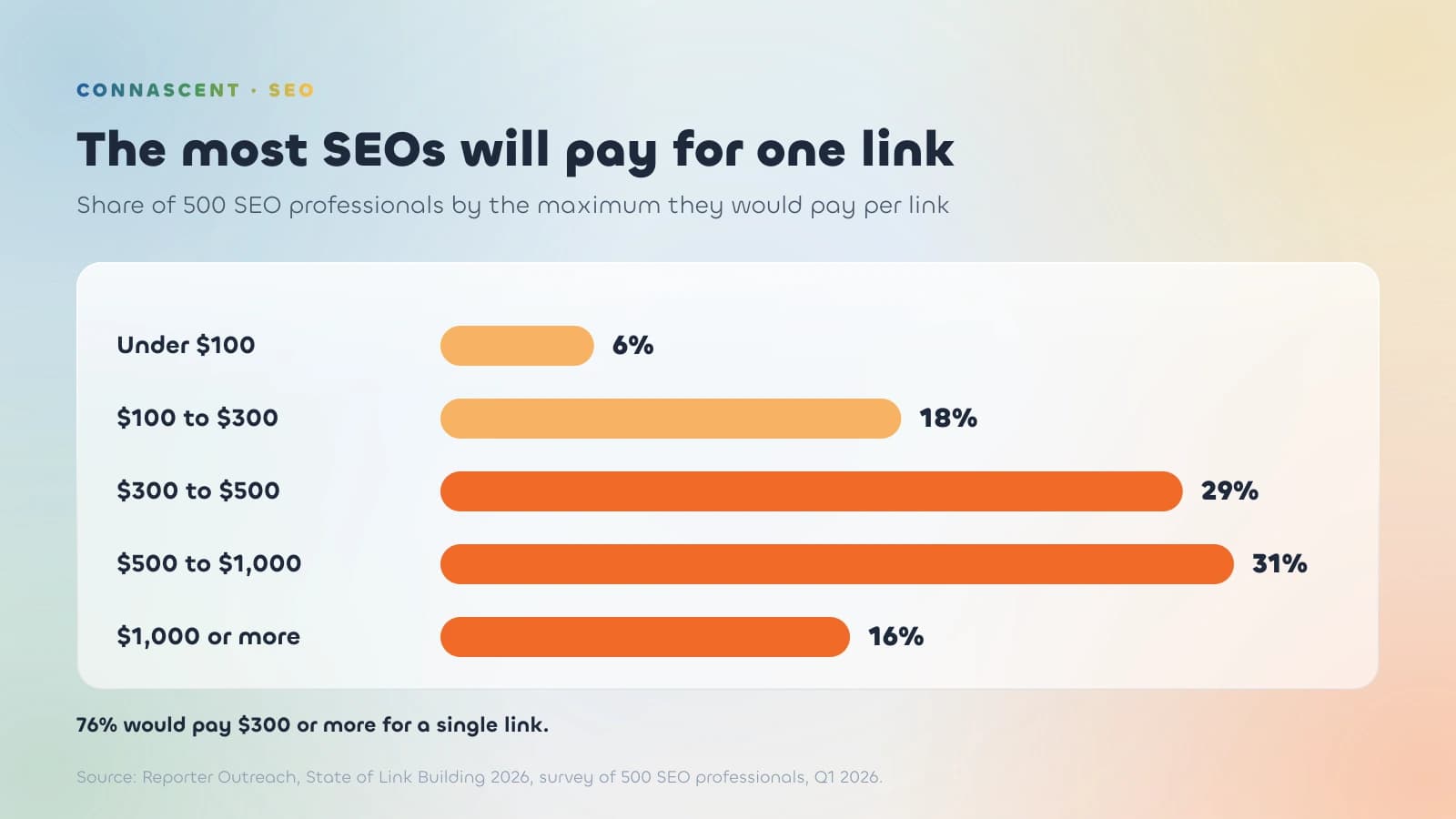
- Digital PR runs $1,250 to $1,500 per unique link. SEO professionals say they would pay $508.95 on average for one high-quality link.
- Retainers usually run $2,000 to $10,000 a month. 64% of 500 SEOs surveyed spend $3,000 or more a month.
- Real organic traffic predicts a link's price better than Domain Rating. 37% of DR 80+ sites that sell links get fewer than 1,000 visits a month.
- Paying a site for a link that passes ranking value breaks Google's spam policy. Paying for outreach and content does not.
- Before you sign, ask for live sample URLs, traffic per target site and a replacement period.
Link building prices at a glance
The range is wide because the rows describe different work. The top half is mostly paying a site owner for space. The bottom half is mostly paying people to create something a publisher wants to link to, and then to pitch it.
The four ways link building is sold
Per link
You pick sites from a list, pay a fee, and a post with your link goes live. This is the cheapest option and the one with the least control. According to Saaslinks' study, 38% of listings ask under $100, and 41% of the sites carry a spam score of 5 or higher.
Per-link pricing is not automatically bad. It is simply the model where all of the checking falls on you.
Packages
A package bundles per-link placements into tiers, such as "10 links, DR 40+". The price per link drops and the transparency usually drops with it. If the package does not name the domains before you pay, you are buying a Domain Rating number, not a set of websites.
Monthly retainers
A retainer pays for a team's time: prospecting, writing, outreach, follow-ups and replacing lost links. Our off-page SEO page quotes the typical range at $2,000 to $10,000 a month, and the surveys agree. Reporter Outreach asked 500 SEO professionals in Q1 2026, and 64% spend $3,000 or more a month.
The number of links per month will vary, because editors decide what gets published. That uncertainty is the point. It is also what separates earned links from bought ones.
Digital PR
A digital PR campaign produces a story, usually built on original data, and pitches it to journalists. BuzzStream's pricing guide puts campaigns at $5,000 to $10,000, typically earning 6 to 7 unique linking domains, or $1,250 to $1,500 a link. Its survey of digital PR providers found an average monthly contract of $5,458.
It costs the most per link, and the links are the hardest to fake: a journalist chose to cite you.
What actually drives the price of a link
Real traffic, not Domain Rating
Most price lists are sorted by Domain Rating, and DR is the easiest metric in SEO to inflate. The Saaslinks data shows how far the two drift apart.
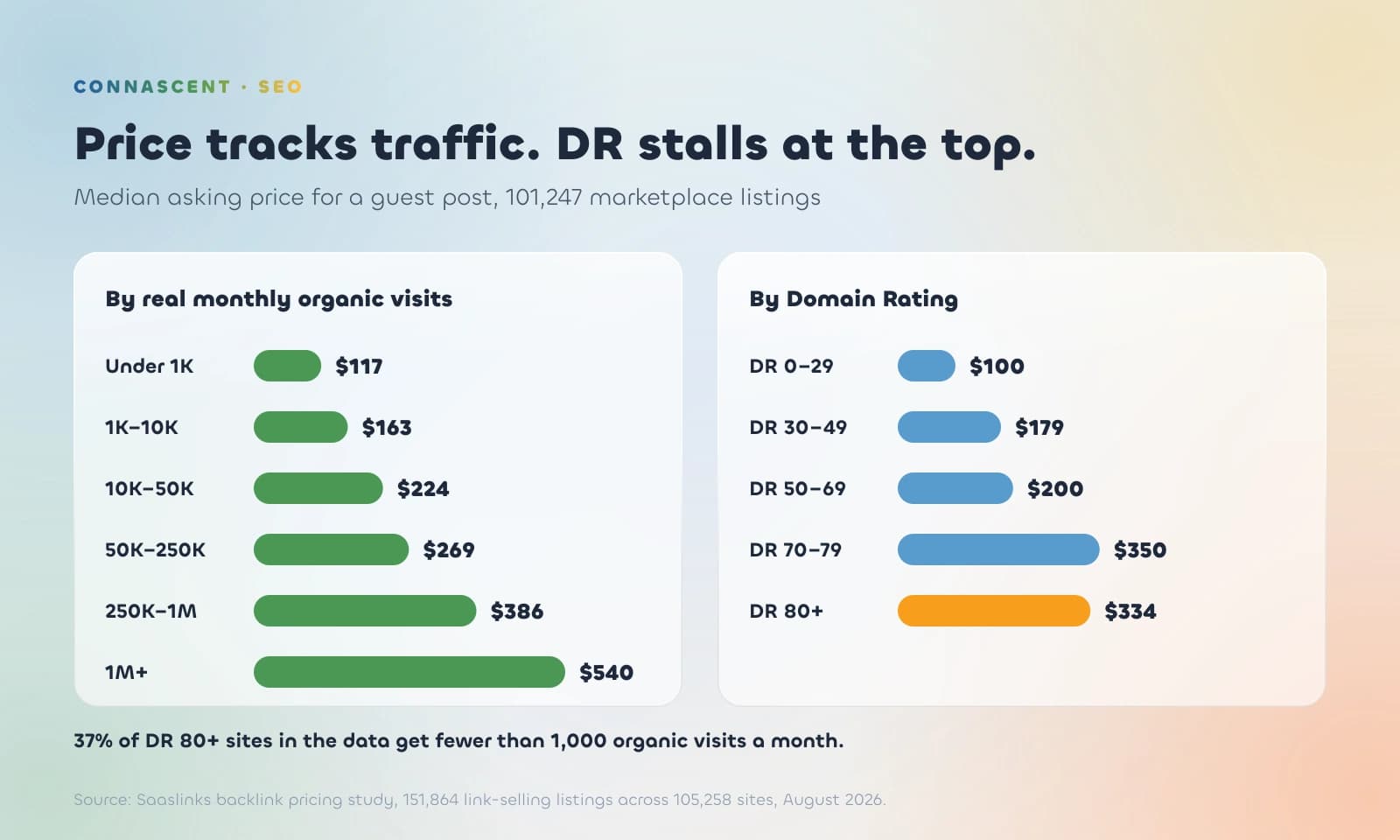
Price climbs steadily with real organic traffic, from a $117 median for sites under 1,000 monthly visits to $540 for sites above one million. By DR it climbs to $350 for DR 70 to 79, then dips to $334 for DR 80+. One in five DR 70+ sites gets fewer than 1,000 organic visits a month, and among DR 80+ sites it is 37%.
A high DR on a site with no readers means the site is good at collecting links, and it will probably sell you one. It says nothing about whether anyone will see yours.
The audience's country
The same study found an 18-fold gap by country. Sites whose traffic is mostly in Sweden asked a median of $420 and German ones $350, against $130 for US-audience sites, $75 for India and $23 for Ukraine. If your customers are in one market, a cheap link from a site read somewhere else is cheap for a reason.
How the link was earned
An editor who published your article because it was useful gives you a different link from a site owner who published it because you paid. Earned links cost more in labour and less in risk.
What the fee includes
Some quotes include the article, some do not. Some replace a link that disappears within a set period, some do not. Two quotes of $300 a link are not the same price once you count the writing and the replacements.
Cheap links and Google's spam policy
Google's spam policies define link spam as creating links "primarily for the purpose of manipulating search rankings." The examples include "exchanging money for links, or posts that contain links." The same page says paid links are fine "as long as they are qualified with a rel="nofollow" or rel="sponsored" attribute value". Those attributes exist to signal that a link should not pass ranking credit.
So a seller offering a followed "DR 50 link for $50" is offering one of two things. Either the link breaks the policy, or it carries a sponsored tag and will not do what you paid for.
The line is about who gets paid, not whether money changes hands. Paying an agency for research, writing and outreach, where the publisher is not paid, is normal marketing. Paying the publisher for the link is the part the policy covers.
Nobody can promise you a penalty or an escape. What we can say is that a site selling followed links to anyone who pays is selling them to everyone else too, and that shows up in its outbound links, where search engines can see it as easily as you can.
How much a small or local business should budget
The survey numbers come from people buying links for competitive niches. In Editorial.link's survey of 518 SEO professionals, the average minimum monthly budget to compete in a highly competitive niche was $8,406. A plumber in one city is not in that market.
A better starting point than any package:
- Search for your main service in your area and note the top three businesses.
- Use a free backlink checker to count how many referring domains each has.
- List the relevant ones you could realistically get: local press, suppliers, trade bodies, your chamber of commerce, clubs you sponsor, event pages.
Many of those cost time rather than money. If the gap to the top three is a dozen relevant local domains, you do not need a $5,000 retainer. You need someone to spend a few weeks asking. Pair it with local SEO work and one page worth linking to, such as a price guide or a local data piece, and budget for writing it through SEO content writing.
A retainer starts to make sense when the gap runs to hundreds of domains, or when the businesses above you are national brands. Links also are not the only off-site signal worth money now. In the Editorial.link survey, 80.9% of respondents said unlinked brand mentions affect rankings, and brand mentions matter even more for being named in AI answers.
How to compare link building quotes
Put every quote through the same questions:
- Which pricing model is it? Per link, package, retainer or campaign. Compare like with like.
- Can you see live sample URLs, or the domain list, before paying? If not, walk away.
- What is each target site's real organic traffic, and what is the 12-month trend? Check it yourself in Semrush or Ahrefs rather than trusting a screenshot.
- What else does the site link to? Open three recent posts. If each one links to a casino, a loan broker and a "write for us" page, so will yours.
- Is the publisher being paid? If yes, ask how the link will be tagged and what that means for its value.
- Is the content included, and who writes it? A thin article on a relevant site still reads as thin.
- Is there a replacement period? Get the length in writing.
- Does the report list every live URL? "15 links at DR 40+" is not a report.
- Is the audience in your market? The country gap in price is also a relevance gap.
A good provider answers all nine without being chased. When BuzzStream screened its own vendor database for authority of 65 and traffic of 10,000 monthly visits, about 1.37% of sites were left. The work you are really paying for is filtering, not placing.
The verdict
Link building is priced by the labour behind a link and the risk you take on, not by a link count. The cheap end of the market is cheap because you do the checking and carry the risk. The expensive end pays people to earn links that editors chose to give.
For most small businesses, the right budget starts smaller than any package: a competitor gap count, a list of relevant local sites and one piece of content worth citing. Buy scale only once you know how big the gap is.
If you want that gap measured before you spend anything, ask for a free estimate. See our off-page link building service for how we approach it, or our wider SEO work if links are only part of the problem.