Enterprises put an average of 12% of their digital budget into AI visibility work last year, and 94% of them plan to spend more this year. Those figures come from Conductor's survey of 250-plus digital leaders at companies with more than 500 employees, published in April 2026.
Ask any of them what the last 12% bought, and the answer gets vague fast.
Here is our answer up front, because the industry has spent a year refusing to give one. Doubling your SEO retainer will not get you named by ChatGPT. The published data is close to unanimous on that, and it also shows which things do track with getting named. Almost none of them are things a retainer produces.
The short version
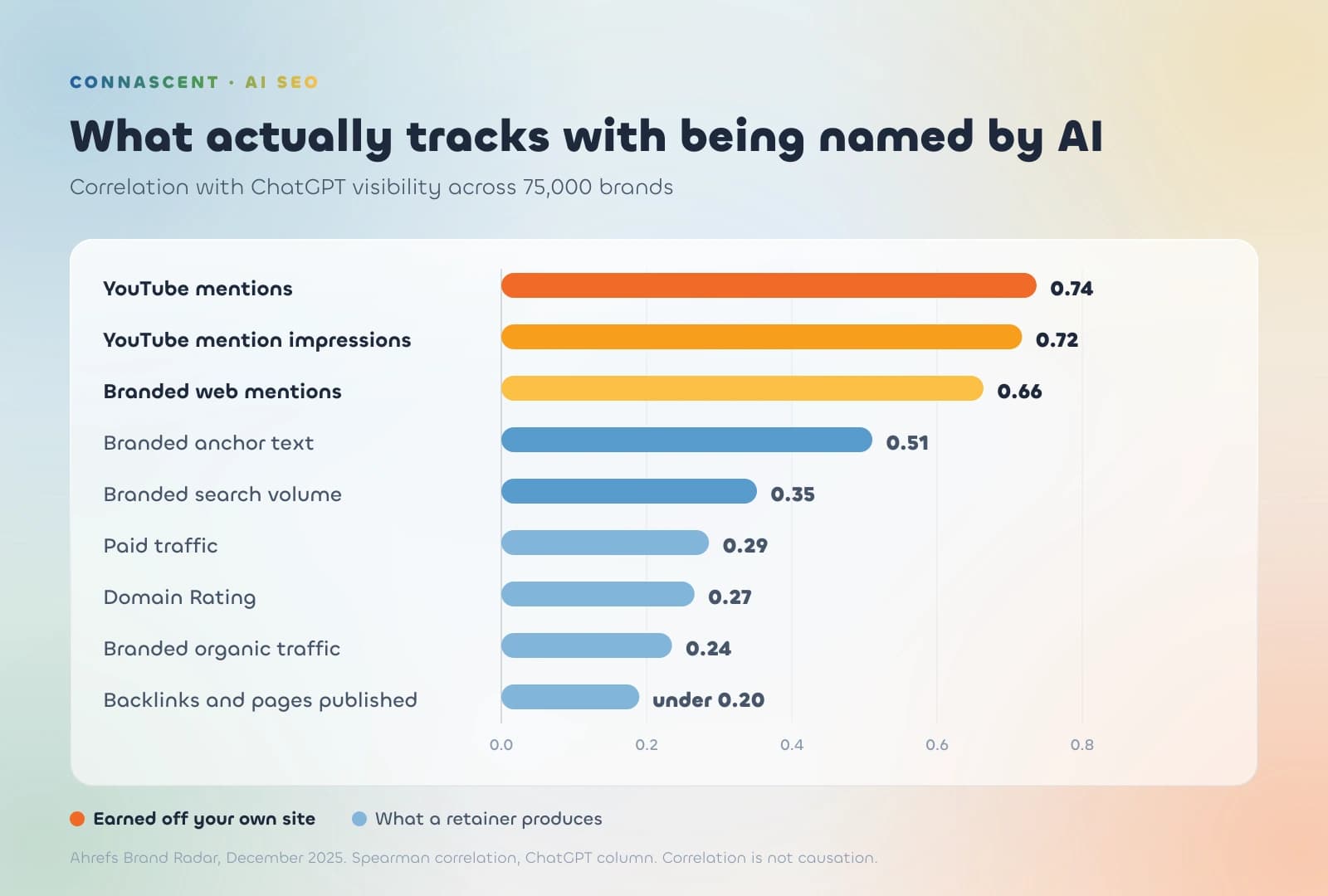
- Across 75,000 brands, the outputs a retainer produces most of, pages and backlinks, correlate with ChatGPT visibility at under 0.20. Mentions elsewhere on the web hit 0.66 and YouTube mentions 0.74.
- Ranking first on Google gets you cited by ChatGPT 43.2% of the time, 3.5x better than page three. It is a floor, not a finish line: 85% of the pages ChatGPT pulls in are never quoted.
- Authority Score, organic traffic and branded search predicted who owns a category barely better than a coin flip across 1,094 categories.
- Your industry decides your ceiling. Over half of all categories have no dominant brand yet. In news and media, the top three hold 82.9% of the visibility.
- Test your own brand with 30 prompts and a spreadsheet before you buy anything. The list of domains cited instead of you is the brief.
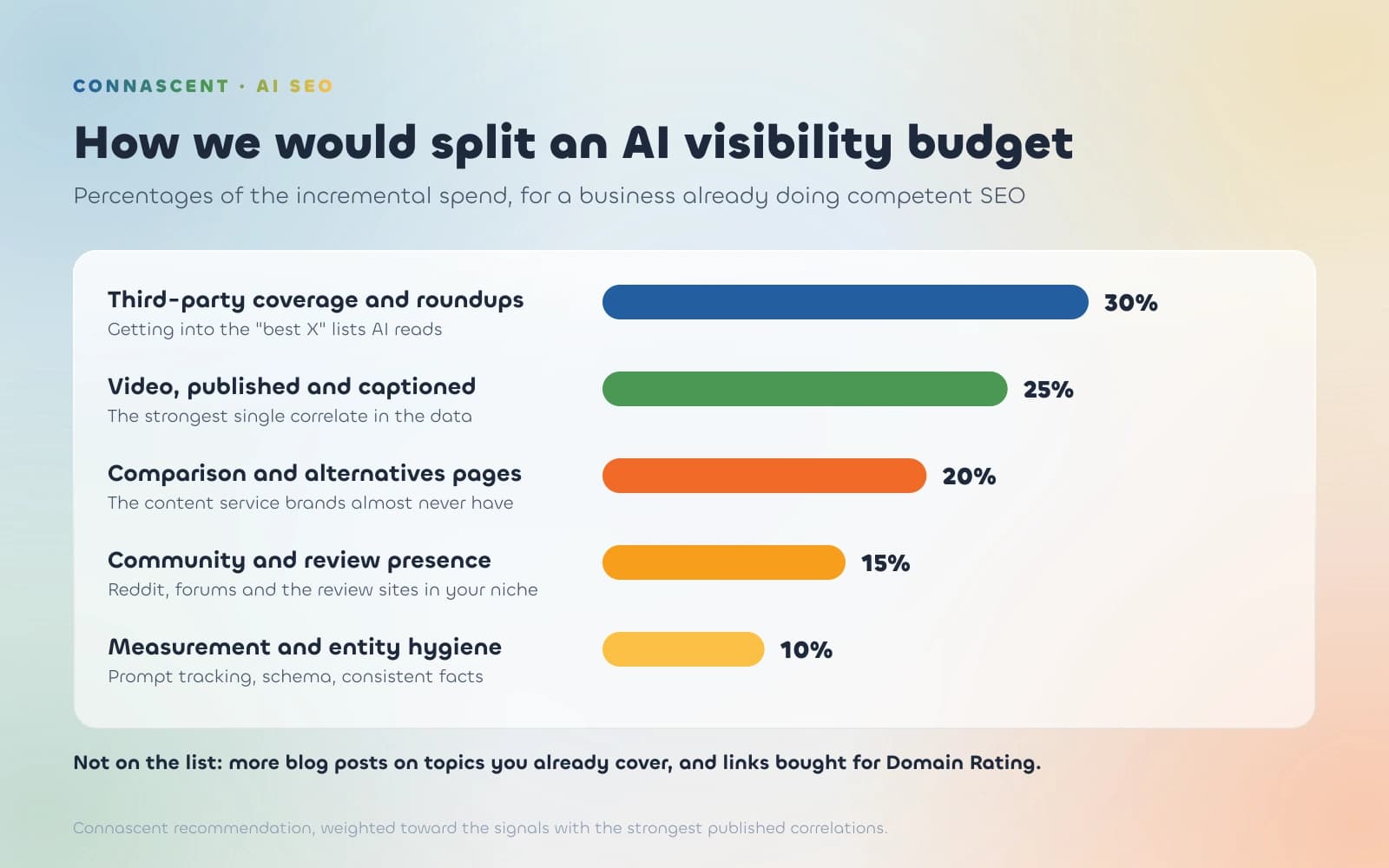
- Our split of an AI visibility budget: 30% third-party coverage, 25% video, 20% comparison content, 15% community, 10% measurement.
The question behind every budget meeting this year
Twelve percent of digital spend is not an experiment, it is a line item. Ninety-seven percent of those leaders said AEO had a positive impact in 2025, and 73% called their own program advanced or very advanced.
In the same survey, measuring the return came out as one of the two biggest challenges. Both things are true at once: people are confident the spending works and cannot show you the arithmetic. Semrush found the same hole from another angle, reporting that 45% of marketing leaders cannot accurately measure their brand's visibility in AI answers, and that only 9% have tooling covering every metric they care about.
Confidence at 97% and measurement at 9% is not a maturing discipline. It is a market buying on faith.
What the correlation data actually shows
The strongest signals are the ones you cannot buy as a line item
In December 2025, Ahrefs ran a correlation study across 75,000 brands with a Domain Rating above 40, matching each brand's presence in AI answers against a set of familiar SEO metrics. Spearman correlations, ChatGPT column:
Read the top of that table and the bottom of it as two different businesses. The top is presence: people talking about you on video, on other people's sites, in the words they use to link to you. The bottom is production: pages shipped, links acquired, authority accumulated. Ahrefs' own summary of the content-volume finding was blunt, saying there is "almost no relationship between content volume and AI visibility."
A retainer is very good at producing the bottom of that table. That is the whole problem in one sentence.
Ranking still matters, as a floor
The obvious objection is that traditional SEO must still count for something, and it does. AirOps published a study in March 2026 covering 15,000 original prompts, 43,233 queries once fan-out was included, and 548,534 pages that ChatGPT retrieved while composing answers.
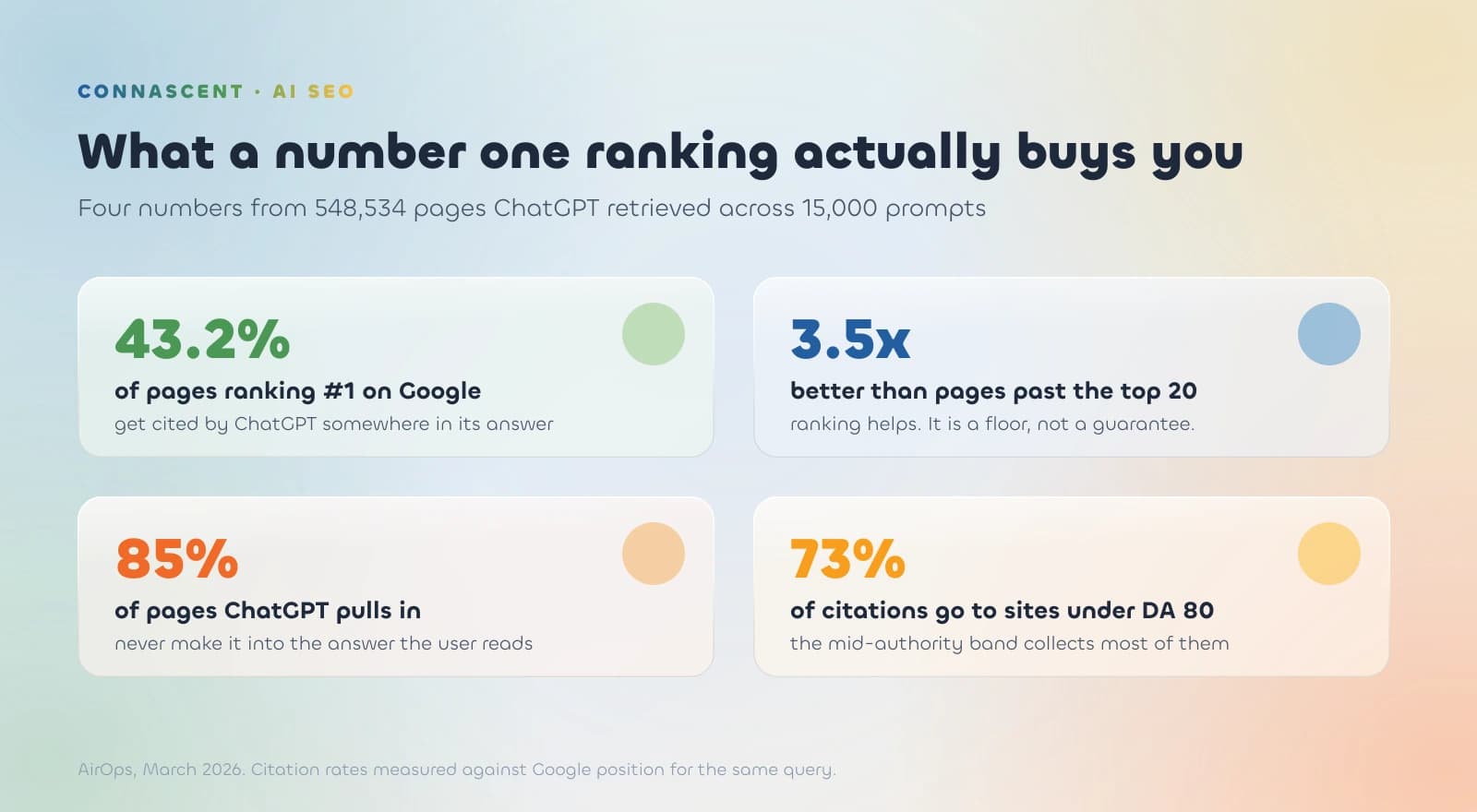
Ranking helps, so anyone telling you classic SEO is finished is selling something. But it buys you a place in the retrieval pool and nothing past that, and most of the pool is discarded before the reader sees a word.
The pool is also wider than your keyword list suggests. Fan-out means 89.6% of searches spawn two or more sub-queries, 95% of those have no measurable search volume, and 32.9% of cited pages surfaced only through one. You cannot buy a rank for a query nobody types.
The authority instinct takes a hit too. The DA 20 to 80 band alone collected 63.6% of all citations, while the DA 80-plus tier gets retrieved constantly and cited at 15%. Being big gets you read. It does not get you quoted.
Topic ownership does not follow authority scores
Semrush and Kevin Indig tracked 1,094 US categories monthly from January to June 2026, covering more than 50,000 brands and five prompts per category. They then checked whether the usual SEO metrics predicted which brand owned a category.
Branded search volume got it right 55.7% of the time. Authority Score, 52.5%. Organic traffic, 48.4%, which is worse than guessing. Their own conclusion was that traditional SEO metrics "aren't enough to explain who owns a topic."
What did predict staying power was margin. Clear owners held their position 90.4% of the time month over month, and the categories that flipped had a median lead of 1.3 points, against 2.9 for the stable ones. Leadership is sticky once the gap is wide, and fragile while it is narrow.
Why more hours buy less than you expect
Retainers are built to produce the cheap signals
Look at what a typical monthly SEO scope contains. Keyword research, on-page fixes, four to eight articles, technical cleanup, a handful of links, a report. Every one of those is measurable, schedulable and repeatable, which is exactly why it fits inside a retainer.
Now match that list against the correlation table. Almost all of it lands in the bottom half.
This is not laziness on anyone's part. It is what happens when a service has to be priced by the hour and reported on monthly. Getting into a credible "best CRM for law firms" roundup takes weeks of relationship work with an unpredictable outcome, and it does not fill a slide.
The signals that matter are slower and sit off your site
The three strongest correlates in the Ahrefs data all live somewhere you do not control. YouTube mentions require someone to make a video. Branded web mentions require someone to write about you. Branded anchor text requires someone to link to you using your name.
Semrush's most-cited domains study, covering 230,000-plus prompts over 13 weeks, put Reddit, Wikipedia, LinkedIn, YouTube and Google at the top of the citation list. Not brand websites. The 2026 index adds that ChatGPT cites around 15 sources per answer while Gemini cites about three, so on Gemini your odds of being one of the three are worse than they look.
If the answer is assembled mostly from other people's pages, then the work that changes the answer is mostly work on other people's pages.
Your agency is probably fine. What they are selling you is not.
Technical health, page speed, internal linking and clean structured data are still why your pages get retrieved at all, and position one still pays. Anyone doing that well is doing necessary work.
The mistake is buying more of it and expecting a different category of result. A fifth article on a scope that already ships four moves nothing, and charging you extra for it under an AI label is the part we would call out.
Your category sets the ceiling before you spend anything
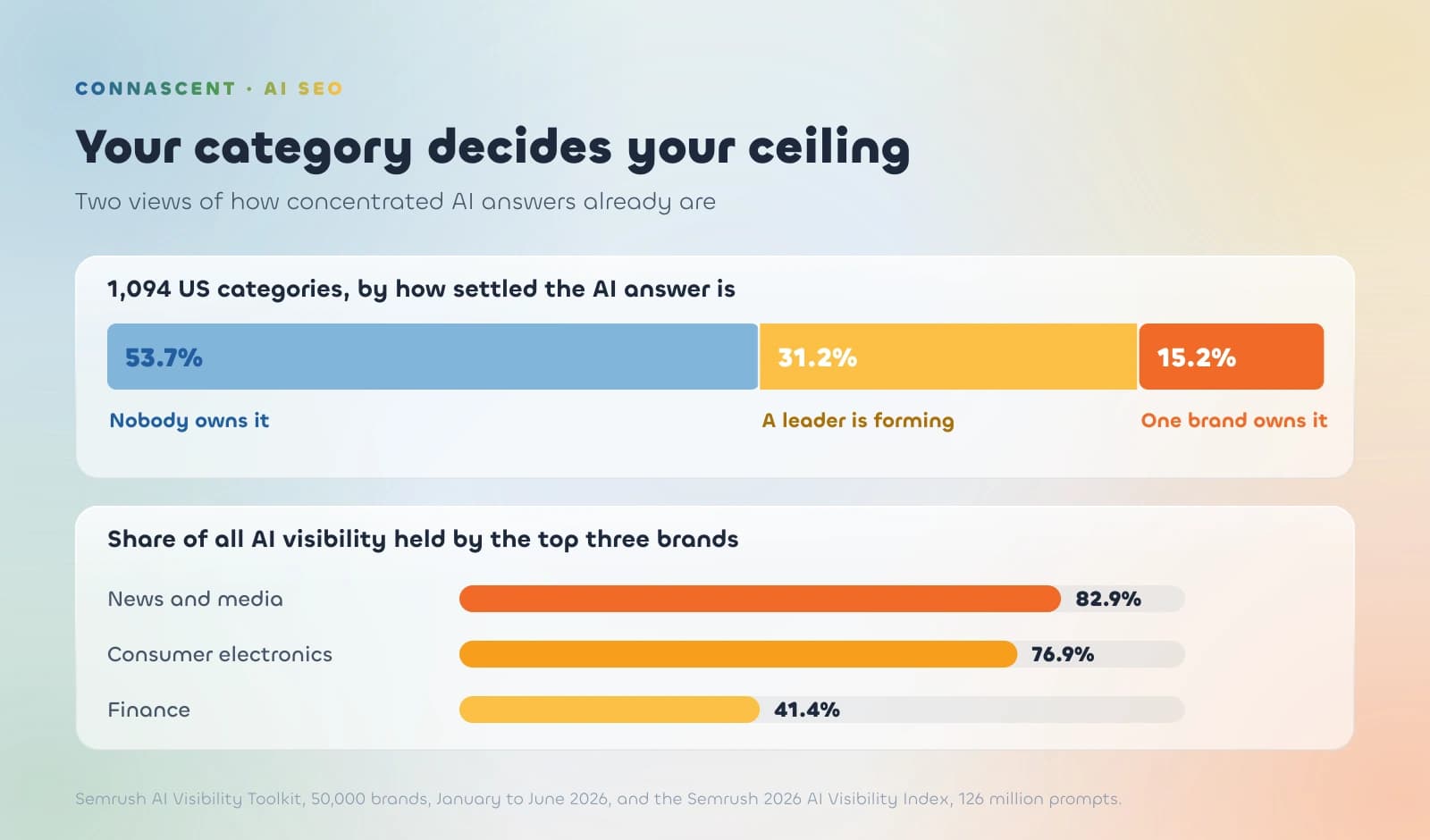
More than half of all categories are still unclaimed
The 53.7% is the biggest opportunity in this article. In most categories the AI answer is still being negotiated, and a focused brand can take it before anyone notices it was available.
The valuable half is the crowded half
Then the catch. Only 11.3% of the top half of categories by demand had a clear owner, and that top half is 98% of all AI search volume. The unclaimed categories skew heavily toward the ones nobody is asking about.
Thirty-six brands, YouTube and Reddit and Amazon and Wikipedia among them, held top-100 visibility across all four platforms every single month of the study. In the concentrated industries you are not competing for the answer. You are competing for a mention inside somebody else's.
A small niche caps your score however well you do
If your category only supports a few dozen realistic prompts, you can be the first name in every one and still post a low visibility score, because the score is a share of a small pool.
So never compare a raw visibility number across categories. Any vendor benchmarking you against an industry average is measuring two different-sized rooms and charging you for the discrepancy.
Where the money does buy AI mentions
Video, because it is the strongest single correlate
YouTube topped the Ahrefs table on all three surfaces and is also one of the most-cited domains across every assistant. Two independent measurements pointing the same way is about as strong a signal as this field offers.
This is not a channel strategy. It is making sure your category's questions have video answers with your name on them: product walkthroughs, comparison videos, conference talks, podcast appearances posted with a real title and transcript. Captions and descriptions carry the weight, because that is the text an assistant can read.
Third-party coverage instead of another page on your site
Getting into "best X" and "top X for Y" roundups is the highest-leverage unglamorous work on this list, and it is the gap almost every service business has, because roundup content for services barely exists next to what products get.
Start with the roundups already ranking for your category terms, since those are the pages assistants retrieve first. Then work the review platforms your buyers actually consult. Same muscle as earning mentions on independent sites.
Comparison and alternatives content
If someone asks an assistant to compare you with a competitor and nothing on the open web does that comparison, the model builds one from what it can find. Usually that is your competitor's page, written to make you lose.
Honest comparison and alternatives pages are one of the few on-site plays with a clear path into AI answers, because they are the exact format the query wants. AirOps backs this up on title matching: pages whose title overlapped the query by 50% or more were cited at 20.1%, against 9.3% under 10% overlap.
Community and review presence
Reddit sat at the top of the most-cited domains list for months, and being discussed there by people who are not you is worth more than most link building.
It is also the most volatile input here. Semrush watched ChatGPT's reliance on Reddit fall from roughly 60% of responses to about 10% within a few weeks in September 2025. Build community presence because your buyers are there. Treat the citations as a bonus.
Entity hygiene and pages a model can extract
Consistent name, address and description everywhere you appear. Schema that matches the page. Clear definitions near the top. Short paragraphs that survive being lifted out of context.
None of it will carry you alone, and it is cheap enough that skipping it is just carelessness.
Run the test on your own brand this week
You do not need to buy a platform to find out where you stand. You need an afternoon and a spreadsheet.
Build 30 prompts
Ten category prompts ("best commercial roofing contractor in Tirana"). Ten comparison prompts ("X vs Y", "alternatives to X"). Ten problem-first prompts, phrased the way a person with the problem would phrase it, before they know your category exists.
Write them as a customer would type them, not as keywords. Fan-out means the assistant will generate its own sub-queries anyway, so a natural sentence is closer to reality than a keyword string.
Record five things per run
Run every prompt in ChatGPT, Gemini, Perplexity and Google AI Mode, logged out, in a fresh session. For each one, write down whether you appeared, your position in the list if you did, which domains were cited, how you were described, and which competitors appeared instead.
The scoring sheet
Detection rate is appearances divided by 120, since 30 prompts across four assistants gives you 120 runs. Anything under 10% means you are effectively absent. Between 10% and 30% means you exist but are not the default answer. Above 50% in your own category prompts means the work now is defending a lead, which the Semrush retention data suggests is much easier than building one.
Keep the prompt list frozen and rerun it monthly on the same day. A changing prompt list produces a changing number that tells you nothing.
What each column tells you to do
The cited-domains column is the most valuable thing on the sheet. It is a literal list of the pages standing between you and the answer, and every one of them is a target: a roundup to get into, a review site to claim, a thread to join.
Low detection with positive descriptions means the material is fine and the reach is not, so push distribution. Frequent appearance in a poor position means you are in the consideration set and losing on evidence, so the fix is proof: reviews, case studies, specifics. Absent everywhere, in a category where somebody clearly owns the answer, means you should read the concentration numbers again before committing a budget to a fight you may not win.
How we would split the budget
What we would cut first
More articles on topics you already cover. Links bought to raise Domain Rating, which costs more than almost anything else here and correlates at 0.27. And any "GEO package" that turns out to be the same content calendar with a new word on the invoice, which describes most of what is being sold right now.
Ask any provider quoting you for AI visibility work which of the signals above their scope actually moves. If the answer is a monthly article count, you have your answer about the provider too.
What to report instead of a visibility score
Report the score, but report it as a diagnostic under revenue and qualified leads, in the same way you would treat Search Console's impressions-only AI report.
There is one survey finding worth acting on directly. Semrush found 81% of organizations with integrated SEO and AI strategies reported traffic or lead gains, against 36% of those running the two separately. Whatever else you do, do not stand up an AI visibility workstream that does not talk to the SEO one.
The limits, including ours
Every study here has a vendor attached
Ahrefs sells brand monitoring, Semrush sells an AI visibility toolkit, AirOps sells content infrastructure, Conductor sells an AEO platform. Each study exists partly to argue that the problem it measures is worth paying to fix. We have the same incentive, so read the budget split as an agency's considered opinion rather than a finding.
Scale is what makes the numbers usable anyway. Seventy-five thousand brands and 126 million prompts are hard to bend to a narrative, and each study publishes enough method for you to argue with it.
The platforms move under you
ChatGPT's Reddit reliance dropped by roughly 50 percentage points in a matter of weeks. AI training data and citation behavior keep shifting, and any snapshot, including these, describes a moment.
Which is an argument for building the durable things. Coverage on sites people trust, video that answers real questions, and a reputation that shows up in the language other people use about you survive a citation reshuffle. A tactic tuned to one platform's current preference does not.
The verdict
Buying more SEO hours is reasonable and it will make your site better. It will not get you named by AI, because the strongest signals in the published data are earned off your own site and cannot be put on a schedule.
The brands winning AI answers are not outspending anyone. They are the ones other people already talk about, in the formats assistants read, in categories where the answer was still open. You can work on the first two directly. Check the third before you commit a budget.
Run the 30 prompts first. If you want help reading the results, or you would rather we built the baseline with you, get in touch or ask for a free estimate. Our SEO and analytics work starts from what the data says, not from what the package includes.