On 17 July 2026, Moonshot AI published the weights to a 2.8 trillion parameter model and told anyone who wanted them to go ahead and download it.
Seven days later Anthropic released Claude Opus 5 and did not mention Kimi at all. It did not need to. Every chart in the announcement had the same thing on the horizontal axis, and it was not a benchmark score. It was dollars.
That is the actual story of this summer. The open models got close enough that the comparison is worth having, and the moment they did, the frontier labs stopped competing on who scores highest and started competing on what a finished piece of work costs.
The short version
- Kimi K3 is the first open-weight model at 2.8 trillion parameters, and it beats Claude Opus 4.8 across most of Moonshot's benchmark suite.
- It is also, by its own technical report, still behind Claude Fable 5 and GPT-5.6 Sol overall.
- On the four benchmarks both vendors publish, Claude Opus 5 takes three and Kimi K3 takes one.
- K3 costs $15 per million output tokens. Opus 5 costs $25. Fable 5 costs $50.
- The bigger shock is internal to Anthropic: Opus 5 outscores Fable 5 on most of Anthropic's own table, at half the price.
What actually shipped, and when
Four releases in seven weeks, which is why this got confusing.
The four releases
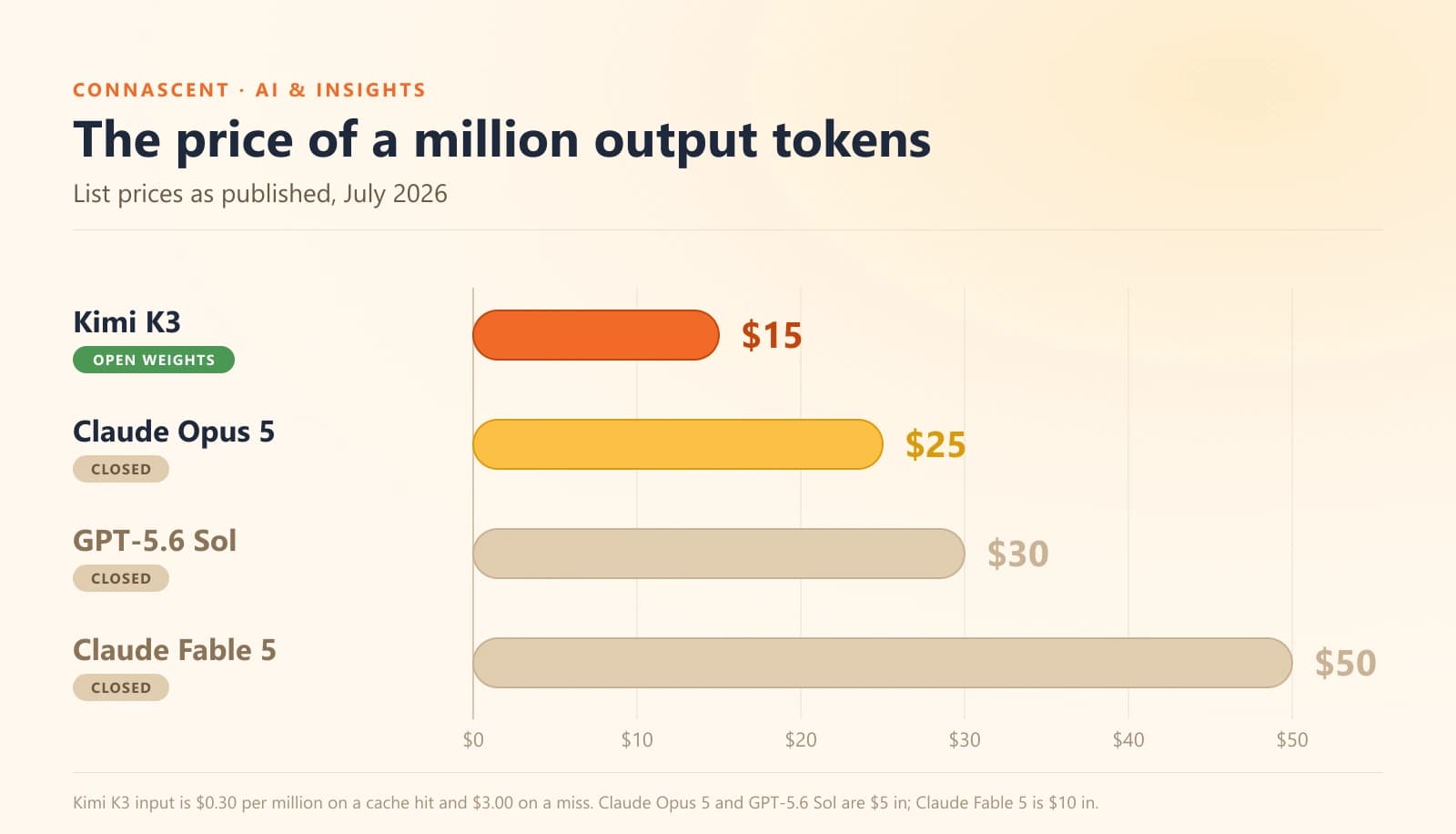
Output tokens are the ones that hurt. Input is cheap on every model here, and Kimi K3 makes it cheaper still by charging $0.30 per million on a cache hit against $3.00 on a miss. If your workload repeats the same long prompt, which most production workloads do, that gap is where the savings actually live.
Why the order matters
Moonshot's technical report compares Kimi K3 against Claude Fable 5, GPT-5.6 Sol, Claude Opus 4.8, GPT-5.5 and GLM-5.2. Opus 5 is not in it, because Opus 5 did not exist yet.
So there is no single table with both headline models in it. You can still compare them, but only by laying one vendor's numbers next to another's, and each vendor runs its own harness. Keep that in mind wherever this article puts a K3 figure beside an Opus 5 figure.
What Moonshot built
The architecture
Kimi K3 is a mixture-of-experts model with 2.8 trillion total parameters, of which 104 billion are active for any given token. It routes to 16 of 896 experts and runs 93 layers, 69 of them using Kimi Delta Attention and 24 using gated multi-head latent attention. The context window is 1,048,576 tokens. Vision is native, through a 401 million parameter encoder Moonshot calls MoonViT-V2.
Two architecture choices are doing the heavy lifting, and Moonshot named both: Kimi Delta Attention and Attention Residuals, which between them move information further along the sequence and deeper through the stack. Combined with a routing scheme the report calls Stable LatentMoE, Moonshot claims roughly a 2.5x improvement in scaling efficiency over Kimi K2.
The practical read on those numbers is the ratio. Only 104 billion of the 2.8 trillion parameters fire for any given token, which is what makes a model this large affordable to serve at all.
Quantization that came first, not last
The weights ship quantized rather than quantized after the fact. K3 was trained with MXFP4 weights and MXFP8 activations, so what you download is what was trained, not a lossy compression of it.
That matters if you plan to host it. With most open models you pick a quantization after release and accept whatever accuracy it costs you. Here the low-precision format was part of training, so there is no separate quality cliff to shop around for.
The demos were games
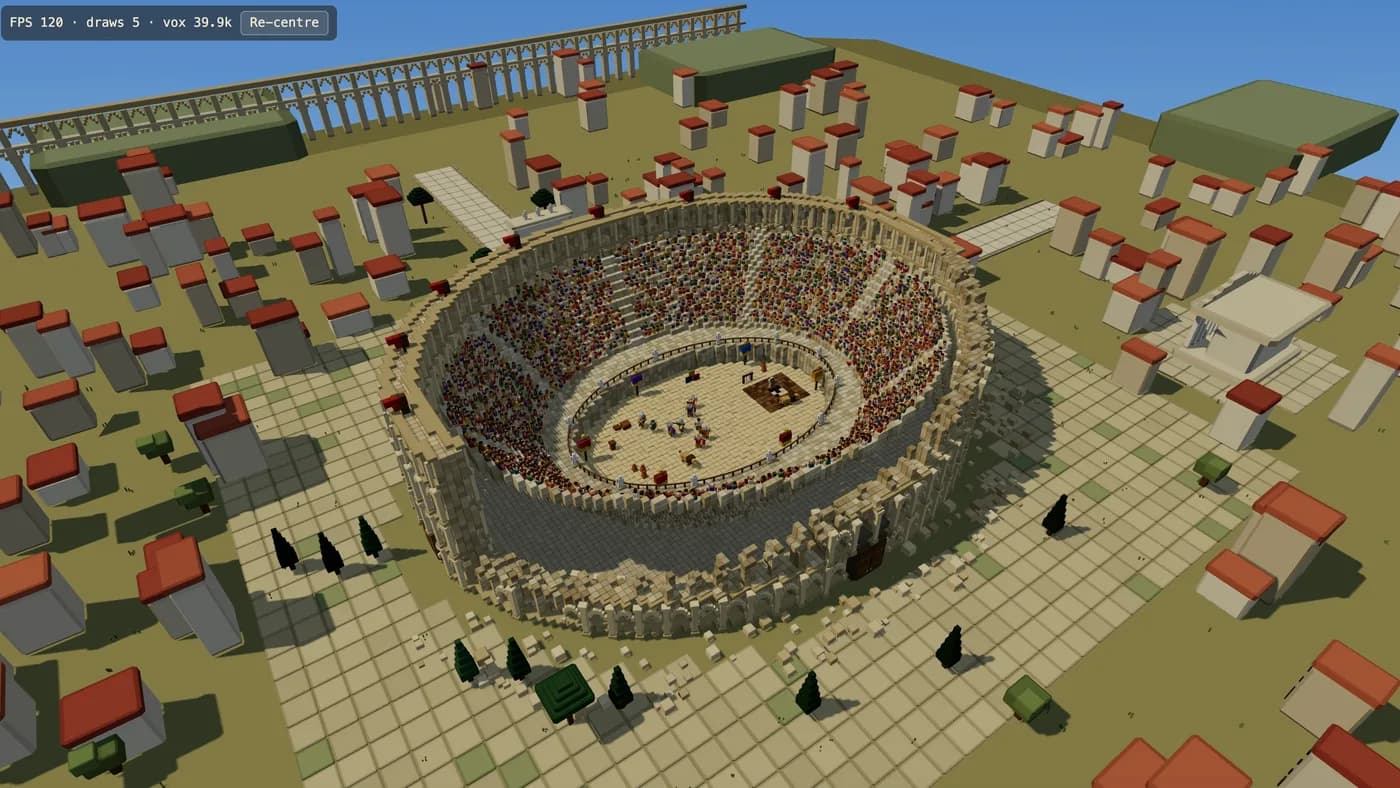
The demos Moonshot led with were games. Not chatbot transcripts, not code snippets, but playable things built in one pass: an open world, a voxel city, a fighting game, a browser physics engine. It is a deliberate choice of showcase, because a game that runs is hard to fake and easy to check.
Kimi K3 against Claude Opus 5, head to head
The four shared benchmarks
Four benchmarks appear in both Moonshot's report and Anthropic's Opus 5 release. They are the only place the two models meet directly.
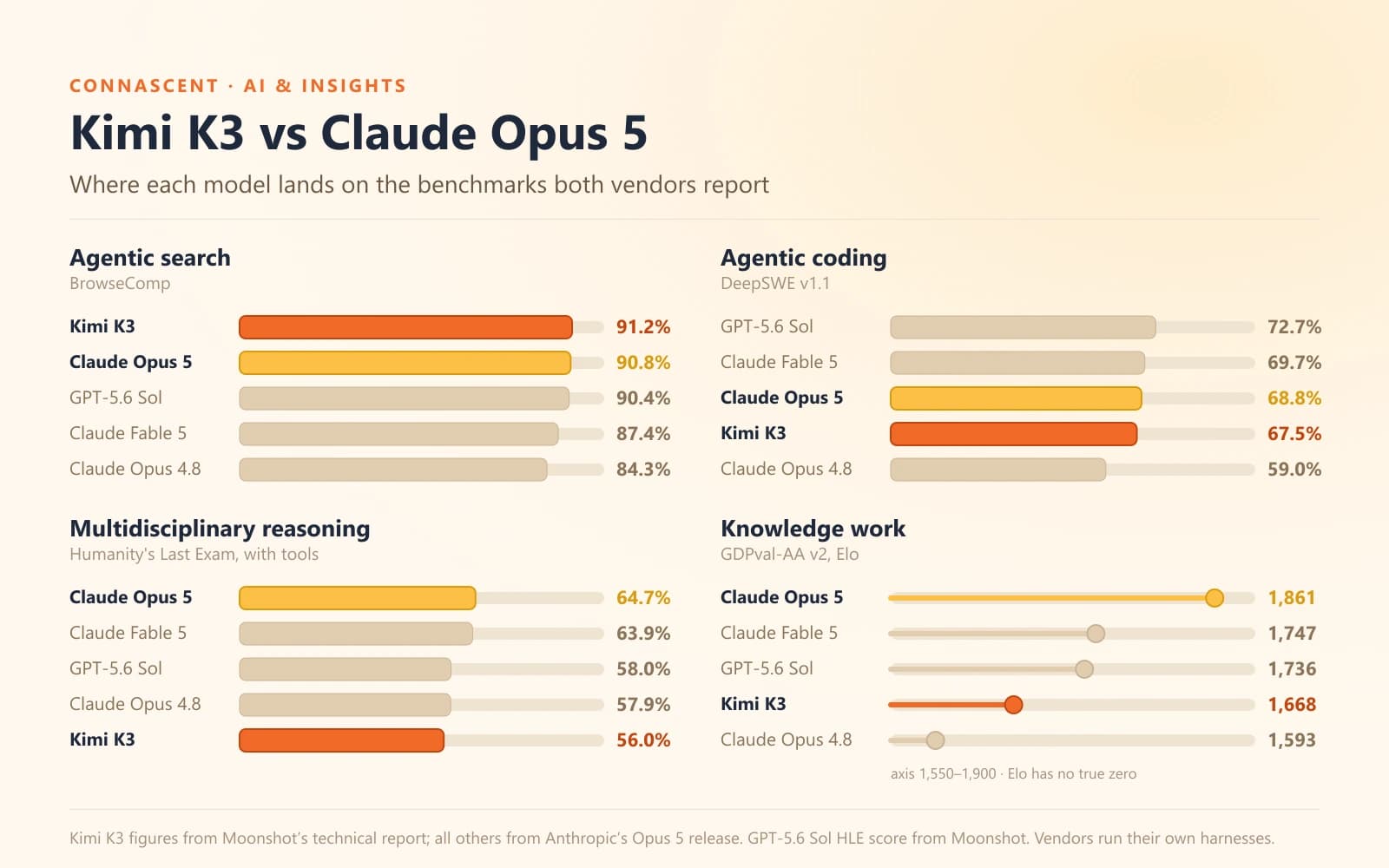
Opus 5 takes three of the four. K3 wins agentic search on BrowseComp by four tenths of a point, which is inside the noise, and loses everything that requires holding a problem in mind for a long time.
Where the gap opens
The Humanity's Last Exam result is the one to look at. K3 reaches 56.0% with tools against Opus 5's 64.7%. That is not a rounding error, it is a different class of answer on research-level questions, and it is consistent with what Moonshot says about its own model elsewhere in the report.
Agentic coding is much closer. On DeepSWE v1.1 the two sit within a point and a half of each other, 67.5% against 68.8%, and GPT-5.6 Sol beats both at 72.7%. If your work is writing and fixing code, the choice between these models is not going to be settled by DeepSWE.
The knowledge-work gap
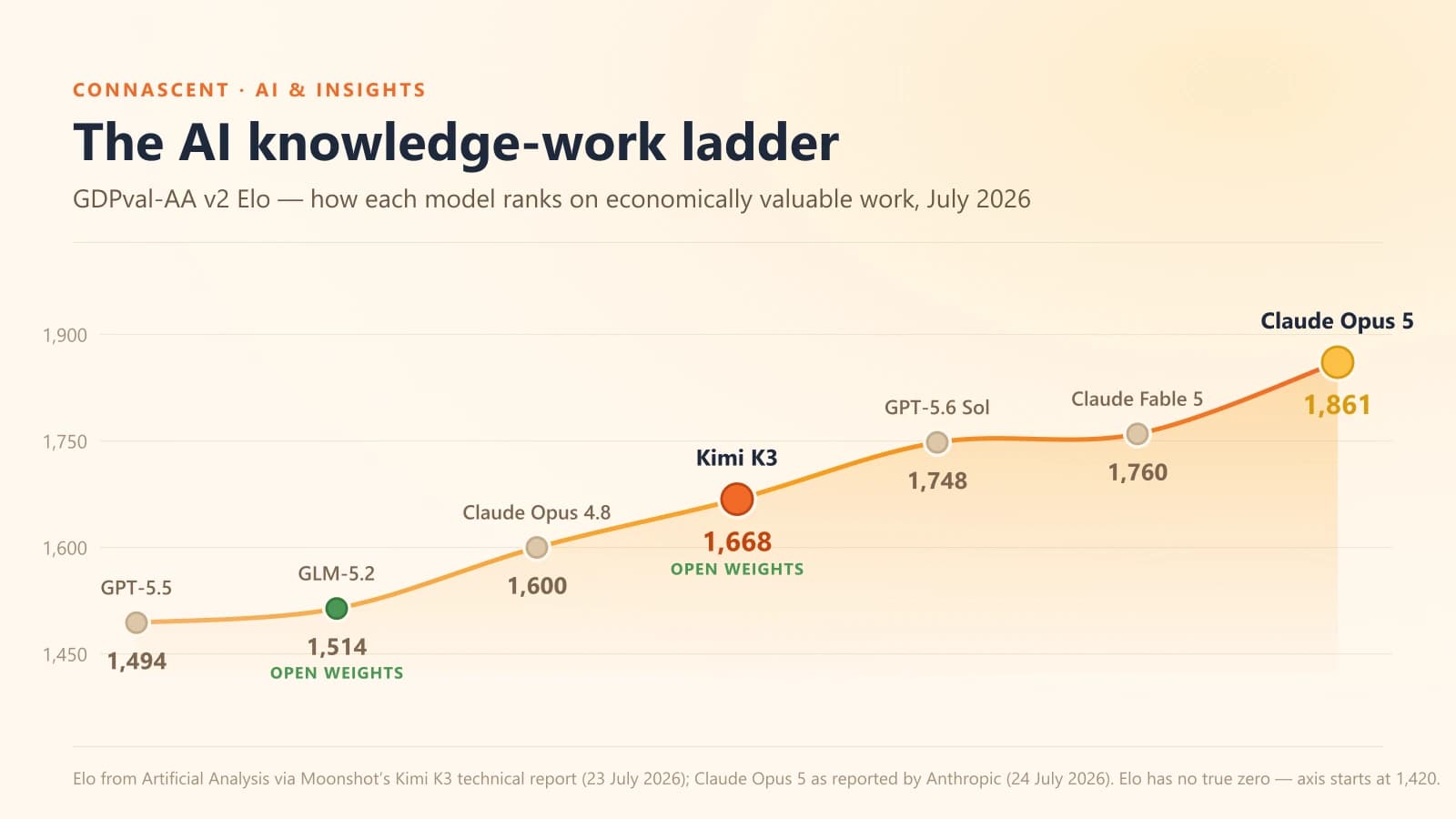
On GDPval-AA v2, which rates how models handle economically valuable professional work, Opus 5 posts 1,861 Elo against K3's 1,668. That is roughly the distance between K3 and Claude Opus 4.8, a model from two generations back.
It is also the widest gap of the four, and the one most likely to show up in ordinary business use. GDPval is built from the kind of tasks people are actually paid to do.
A caveat on reading two vendors' tables together
Every number in this section comes from the company that makes the model. Moonshot ran K3 on Moonshot's harness; Anthropic ran Opus 5 on Anthropic's. The two disagree slightly even where they measure the same thing: Anthropic puts Fable 5 at 1,747 on GDPval where Moonshot puts it at 1,760, and their AutomationBench figures diverge far more than that because they used different task subsets.
None of which makes the comparison useless. It does mean a one-point difference between a Moonshot number and an Anthropic number tells you nothing, and only the large gaps are safe to reason from.
Where Kimi K3 genuinely wins
An open-weight model holding the top spot on any frontier benchmark would have been unthinkable a year ago, and K3 holds several.
First place on WebDev Arena
WebDev Arena — Elo, human preference on web development tasks
K3 sits first out of 99 models on WebDev Arena, where humans vote on which model built the better web page. That is a preference score rather than a capability test, and it is the one benchmark here that maps most directly onto what a web agency actually does all day.
Worth noting what it measures: not whether the code is correct, but whether a person looking at two results prefers one. For front-end work that is often the question that matters.
Coding and agentic results
It also takes the best score in Moonshot's suite on ProgramBench at 77.8%, on OmniDocBench at 91.1%, on AutomationBench at 30.8%, on DeepSearchQA at 95.0% F1, and on SpreadsheetBench 2 at 34.8%.
On SWE-Marathon, a suite built around GPU kernel work, it scores 42.0% and beats Claude Fable 5 by seven points. On Terminal-Bench 2.1 it lands at 88.3% against GPT-5.6 Sol's 88.8%, close enough to be noise. On FrontierSWE, a long-horizon benchmark, it takes second at 81.2% behind only Fable 5 at 86.6%, and ten points clear of GPT-5.6 Sol.
The BrowseComp result is about price
Moonshot measured K3 at 91.2% on BrowseComp for $2.03 per task. The report notes that is half what GPT-5.6 Sol costs for 90.4%, and an order of magnitude cheaper than the Claude models running at maximum effort.
This is the single clearest example of the shift the whole article is about. Same score, tenth of the bill.
What independent scoreboards say
Artificial Analysis has K3 at 57.1 on its Intelligence Index v4.1, fourth of 580 models, behind Fable 5 at 59.9 and GPT-5.6 Sol at 58.9 but ahead of Claude Opus 4.8 at 55.7. Vals AI puts it second of 39. Both readings are from 23 July 2026, before Opus 5 shipped.
Where it does not
Moonshot's own verdict
Moonshot's report is unusually blunt about this, and the bluntness is the most credible thing in it. K3's performance "still trails the most powerful proprietary models, namely Claude Fable 5 and GPT-5.6 Sol." Elsewhere the report admits a "noticeable gap in user experience."
Vendors do not normally write that about their own launch. Take it at face value.
The scores behind the admission
Wherever sustained reasoning matters more than fast retrieval, K3 slips. On Humanity's Last Exam it reaches 43.5% alone and 56.0% with tools, behind both frontier models either way. On GDPval-AA v2 it places third at 1,668 Elo behind Fable 5 at 1,760 and GPT-5.6 Sol at 1,748. On JobBench it trails Fable 5 by four and a half points, and on Kimi Code Bench 2.0, Moonshot's own internal coding suite, it loses to Fable 5 by four.
What "excessive proactiveness" means in practice
The report describes the model as prone to excessive proactiveness during long tasks. In plain terms, it does things you did not ask for: refactors code you only wanted read, extends a brief you wanted answered narrowly, keeps going when it should stop and check.
That is a manageable problem if a person reviews the output. It is a real cost if you were planning to leave the model running unattended for an hour, which is exactly the job the frontier closed models are being sold for.
The full benchmark table
How to read it
Moonshot's complete comparison, across coding, agentic work, reasoning and vision, with Claude Opus 5 added wherever Anthropic reports the same benchmark. A dash means that vendor does not publish a figure for that row, not that the model scored zero.
From the Kimi K3 technical report, with the Opus 5 column from Anthropic's announcement. All models at maximum reasoning effort, GPT-5.5 at xhigh. Claude Fable 5 results include its safety fallbacks; GPT-5.6 Sol results include cyberguards.
What Anthropic did about it

The price stayed, everything under it moved
Claude Opus 5 arrived on 24 July at $5 per million input tokens and $25 per million output tokens, which is exactly what Claude Opus 4.8 cost. The price did not move. Everything under it did.
Anthropic's own numbers
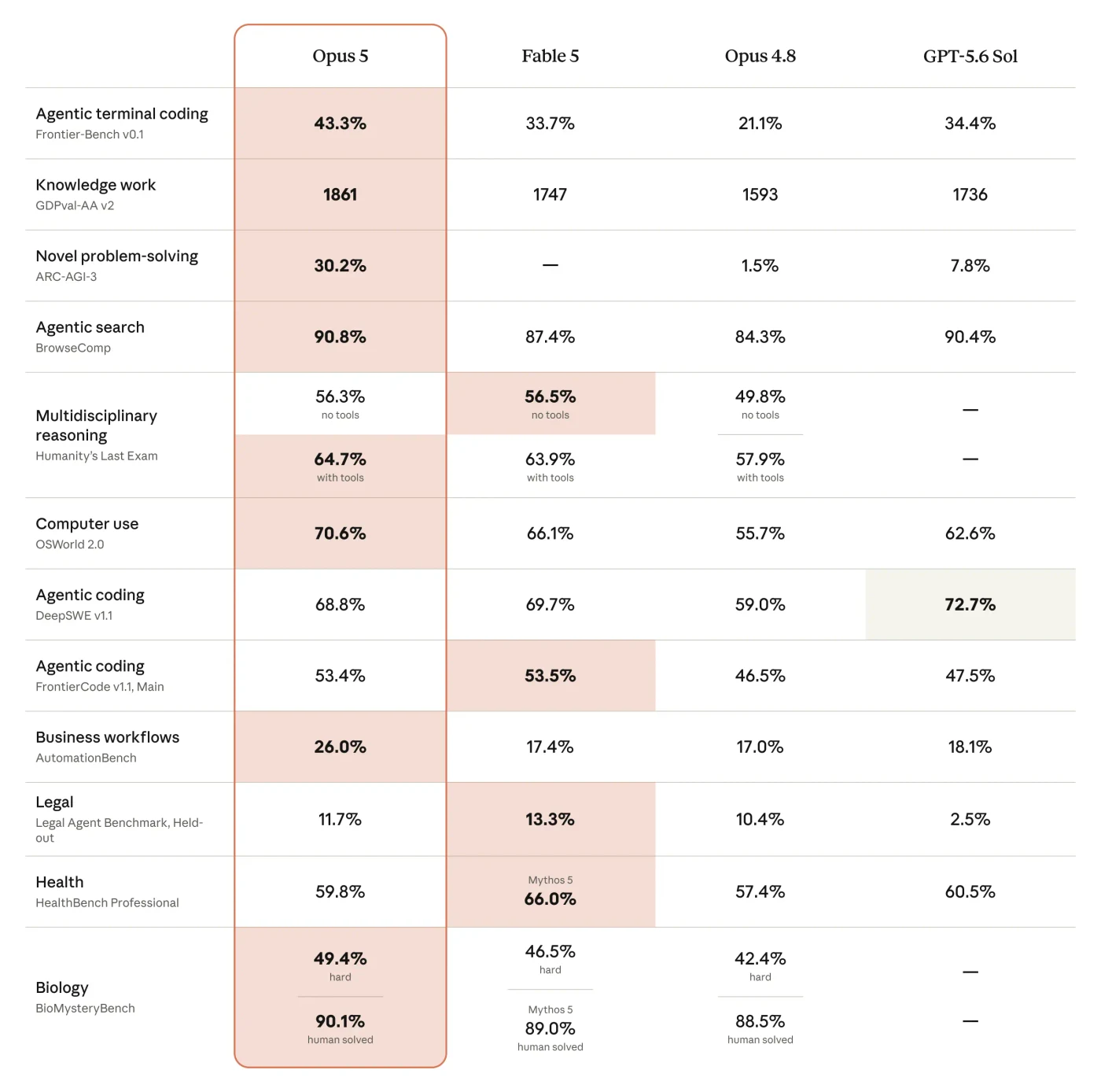
From Anthropic's Claude Opus 5 announcement.
Frontier-Bench and ARC-AGI-3
The headline number is Frontier-Bench v0.1, where Opus 5 scores 43.3% against Opus 4.8's 21.1%. Twice the score at the same price, one release apart.
On ARC-AGI-3, a test of novel problem-solving, it posts 30.2% where GPT-5.6 Sol manages 7.8% and Opus 4.8 manages 1.5%. Those are low absolute numbers on a deliberately hard test, and the ratio is the point rather than the score.
The awkward part: Opus 5 passed Fable 5
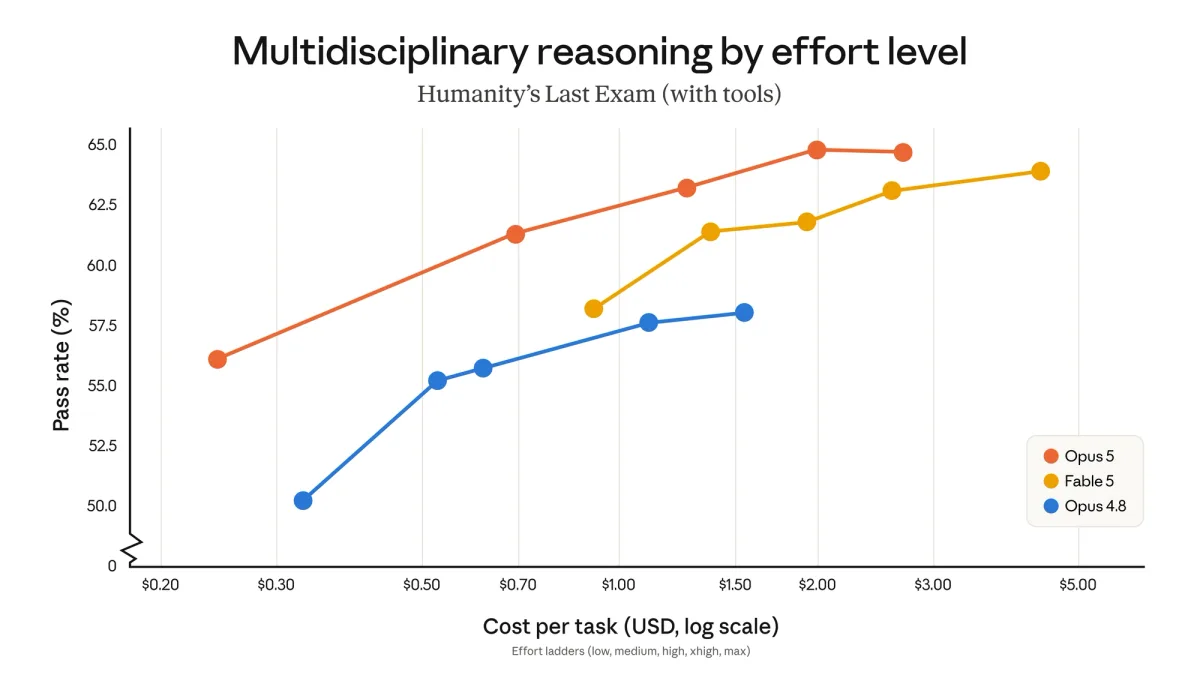
The genuinely uncomfortable result for Anthropic is the Fable 5 column. Opus 5 beats it on Frontier-Bench, GDPval, BrowseComp, OSWorld 2.0, AutomationBench and Humanity's Last Exam with tools.
Fable 5 clings on to DeepSWE v1.1, FrontierCode and the legal benchmark by fractions of a point, and Mythos 5 still leads on health and biology. But Fable 5 launched in June as a Mythos-class model, a tier explicitly above Opus, at twice the price. Seven weeks later the Opus tier passed it.
If you are paying $10 and $50 per million tokens for Fable 5 today, that table is worth ten minutes of your time.
The cost curves
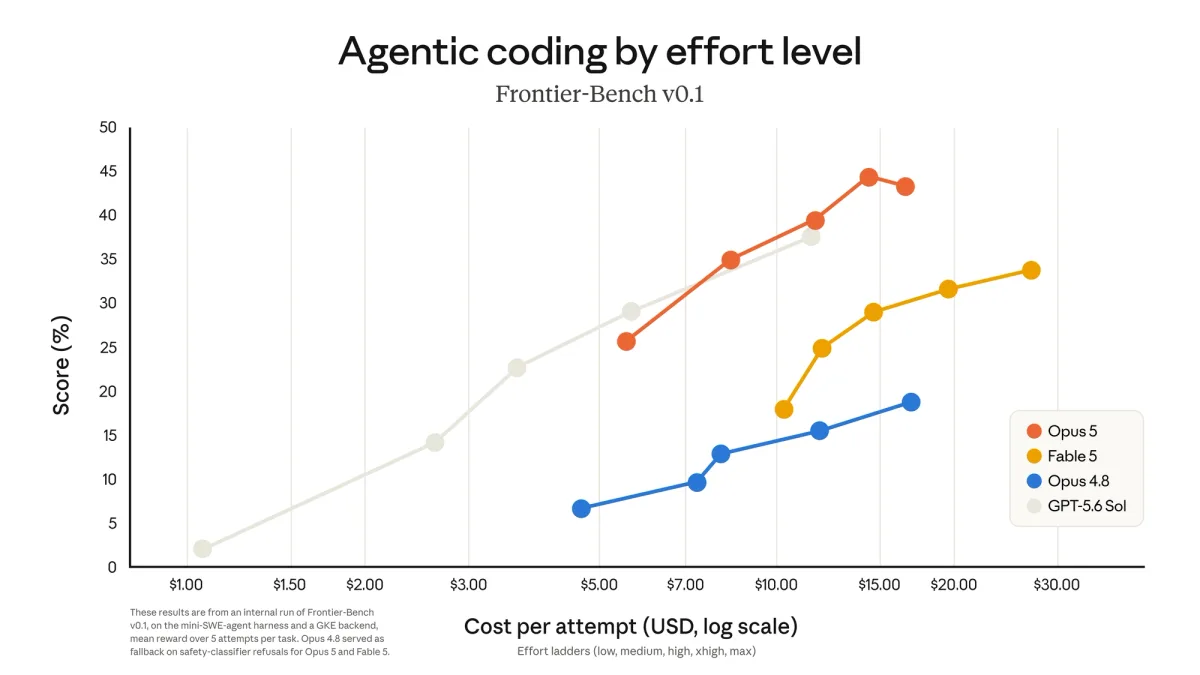
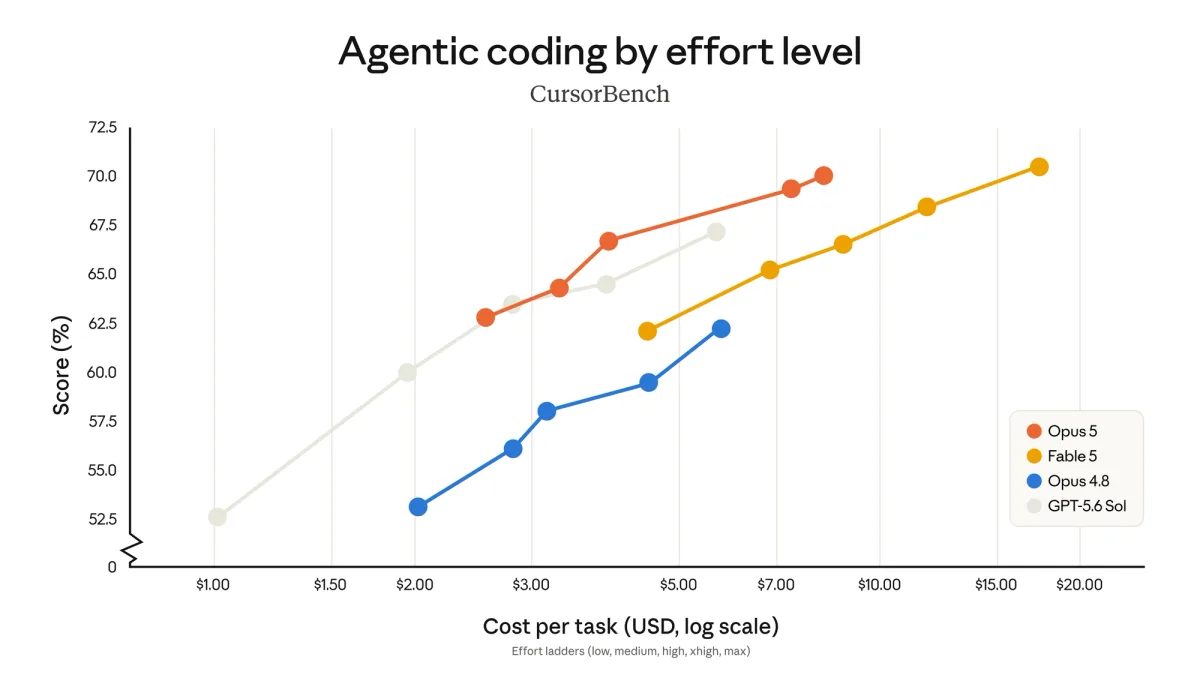
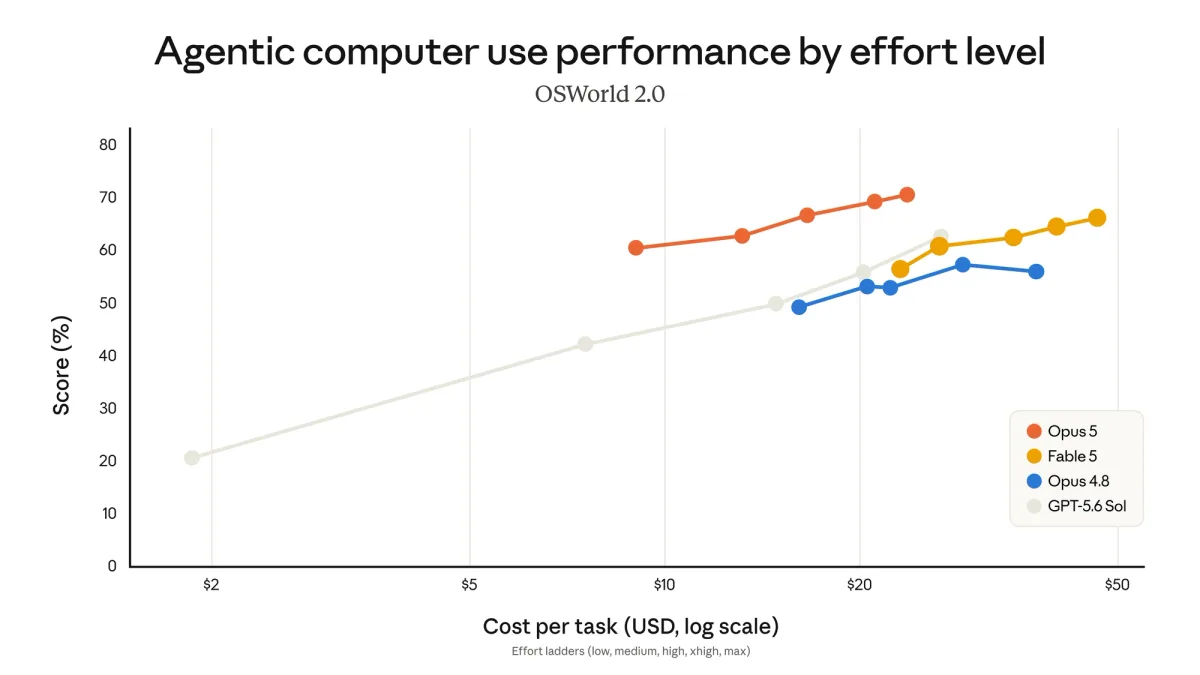
Read these two the same way. The horizontal axis is money, the vertical axis is score, and Opus 5 sits above Fable 5 at every point along the curve. A line that is higher everywhere means there is no budget at which the older, dearer model is the better buy.
Where Fable 5 and Mythos 5 sit now
Fable 5 launched on 9 June as the first publicly available model in what Anthropic calls the Mythos class. It ships with safeguards that hand cybersecurity and biology requests back to Claude Opus 4.8, which Anthropic says happens in fewer than 5% of sessions.
Mythos 5 is the same model with the cyber restrictions lifted. It is not generally available, going only to Project Glasswing partners and vetted biology researchers, and it still leads Opus 5 on health and biology work.
And GPT-5.6 Sol
GPT-5.6 Sol is OpenAI's top tier of a three-model family alongside Terra and Luna, at $5 and $30. Artificial Analysis scores it one point behind Fable 5 on intelligence and first on the Coding Agent Index. It also holds the best DeepSWE score in this article at 72.7%, so for pure agentic coding it remains the one to beat.
The unit that changed
Cost per finished task, not cost per token
Here is what all four releases have in common, and it is not architecture.
Every serious comparison published this summer measures cost per completed task instead of score per benchmark. Anthropic's charts plot dollars on a log scale. Moonshot's report argues its case in dollars: $2.03 per BrowseComp task, within 50 Elo of GPT-5.6 Sol on GDPval at 13% lower cost, 2.6 times cheaper than Fable 5.
Why everyone switched to that unit
Raw capability stopped being the constraint. When four models all clear 88% on the same coding benchmark, the interesting question is no longer which one is smartest. It is which one finishes the job on the first attempt, because a model that needs three tries at $5 is more expensive than one that needs a single try at $10.
Token price also stopped predicting the bill. A cheaper model that reasons for longer, or retries more often, can cost more per finished piece of work than a dearer one that gets there directly.
The number to ask a vendor for
If you are evaluating AI for your business, ask for cost per completed task on work that resembles yours. Not the benchmark score, and not the per-token rate.
The version you can measure yourself is simpler still: the bill at the end of the month, divided by the number of things that actually got done.
So which one should a business use?
Pick by job, not by leaderboard
Depends entirely on the job, and for most companies the answer is more than one.
The argument for weights you hold
That last row is the one people underrate. Every closed model on this page will be retired eventually, and the version you built your workflow around will stop answering. A downloaded set of weights will not.
For a business automating something it intends to run for years, that is a real consideration and not an ideological one. It is also the only reason on the list that has nothing to do with benchmarks.

What this means if you are not building AI products
Most businesses reading this are not choosing between mixture-of-experts architectures. They are wondering whether any of it changes what they should do next. Two things do.
Cheaper models change what is worth automating
Work that made no economic sense at $50 per million output tokens is worth doing at $15. That covers most of the unglamorous production in marketing: product descriptions at scale, translating a site into three languages, alt text for a thousand images, first-pass content briefs.
If you priced that out a year ago and decided against it, the arithmetic is different now. Our SEO content writing work runs on exactly this shift.
Bigger context windows change the quality of the advice
Kimi K3 and the recent Claude models all take a million tokens, which is enough to hold your entire website, your three closest competitors, and a year of search data in one pass.
A model reasoning over all of that at once gives you better answers than one reading it in fragments. That is the practical reason AI-driven SEO has moved from novelty to routine, rather than anything to do with the models being cleverer.
What has not changed
Any of this needs something to point at. A model that can read your whole site is only useful if the site says something worth reading, and an AI assistant will only cite a page it can actually reach.
That part is still ordinary web development and ordinary search engine optimization. The models got cheaper. The requirement to have something worth indexing did not go away.
The thing worth remembering
A year ago the gap between the best open model and the best closed one was wide enough that the comparison felt silly. This summer an open-weight model took first place on WebDev Arena, matched the frontier on graduate-level reasoning, and did it at a fifth of the price, then published a report admitting it still loses on the hardest work.
Anthropic's answer was not a higher score at a higher price. It was a model that beats its own premium tier while costing half as much to run.
Both of those facts point the same direction. Capability is becoming a commodity and price is becoming the battleground, which is good news if you are buying rather than selling. If you want to work out which model belongs in which part of your business, talk to our team or start with a free estimate. The models will change again by autumn. The way you decide between them should not have to.