A click on "dental implants near me" costs about $18 in Google Ads. Bids at the top of the page run up to $50. The organic version of that search has a keyword difficulty of 14 out of 100.
That gap is the case for SEO in one line. The searches that bring the most valuable patients are expensive to buy and cheap to rank for, because most dental websites are a homepage, a services list and a stock photo of a smile.
Every agency guide on this says yes. We sell SEO and Google Ads, so we'll also tell you who shouldn't buy it yet.
The short answer
- Yes, for most US practices with open chair time. A third of dentists say they aren't busy enough.
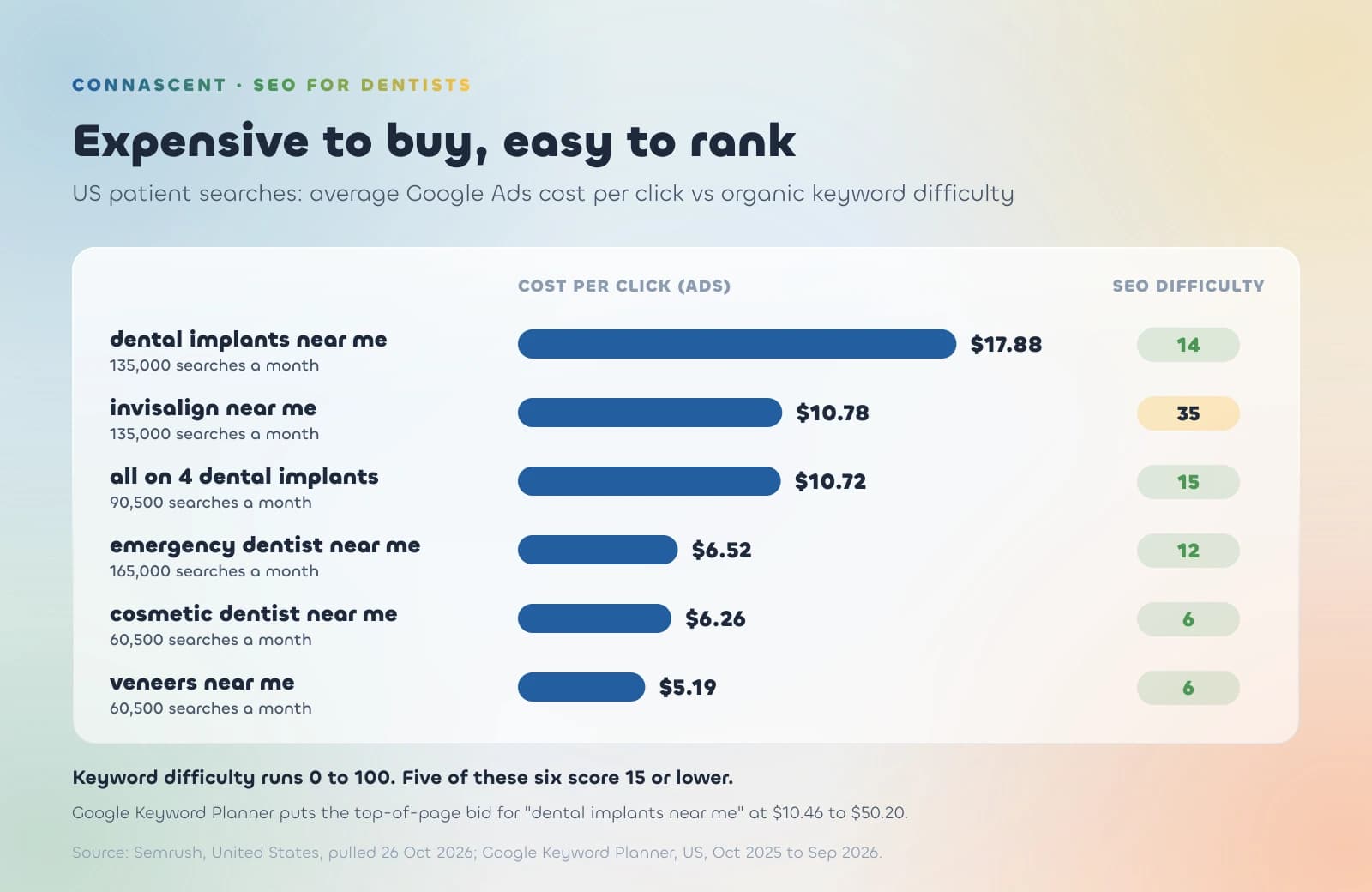
- Implant and cosmetic clicks cost $5 to $18 on average in ads, yet five of the six searches we checked score 15 or lower for organic difficulty.
- At national average fees, one implant case a month covers a $1,500 retainer.
- Your licence, your credentials and your reviews are ranking signals. Put them where Google can read them.
- Wait if you're fully booked, moving or rebranding soon, or need patients this month.
Is SEO worth it for dentists? Our verdict
Yes, if you have room in the book and want more elective work. If implants, aligners and cosmetic cases are where your margin is, SEO isn't a nice extra. It's the cheapest way to get in front of people who have already decided they want the treatment and are only choosing who does it.
Why SEO for dentists pays differently
For most local businesses, SEO is the slow, cheap alternative to ads. For dentists it's more than that, for three reasons.
Dental ads are some of the most expensive local clicks
Patients searching for a treatment by name are worth a lot, and every DSO in your area knows it.
What dental implant clicks cost in Google Ads
Semrush puts the average click on "dental implants near me" at $17.88, and Google Keyword Planner puts the top-of-page bid at $10.46 to $50.20. At an illustrative 10% click-to-consultation rate, that's about $180 per consultation before anyone has said yes to treatment.
Why organic rankings are cheap by comparison
The same searches score 6 to 15 for keyword difficulty, apart from Invisalign at 35. Low difficulty means the pages ranking today are beatable: a well-built treatment page can compete with the chains and directories that rank now. A treatment page that answers the patient's questions properly has a real chance.
A third of dentists have chair time to fill
The ADA's Health Policy Institute found that in early 2026, one in three dentists said their practice wasn't busy enough, up from one in four in early 2024. Capacity is opening up as practices face a continuing fiscal squeeze. When the problem is empty chairs, not demand, the answer is being found by the patients who are already searching.
Insurance networks and DSOs own part of the results page
When we searched "dental implants near me", the results after the map included Aspen Dental with 1,100+ offices, Delta Dental's find-a-dentist directory, Yelp and a handful of implant centres. In-network patients can find you through their insurer. Patients paying privately for implants, aligners or veneers mostly find you through Google.
That's why SEO matters most for the work insurance pays least for.
What patients search: dental keywords in the US
What US patients search each month
Treatment searches beat "dentist near me"
"Dentist near me" gets a million searches a month and has a keyword difficulty of 76. You'll compete for it through your Business Profile, not your website. The treatment searches are smaller, easier and worth far more per patient. Build for those.
Cost searches are a door in
"Dental implants cost" gets 90,500 searches a month, "invisalign cost" 74,000 and "full mouth dental implants cost" 60,500. A practice that publishes honest price ranges on its treatment pages answers the question patients ask before they book, and most competitors still hide prices behind "call for a quote".
Insurance searches are SEO pages too
Searches like "dentist near me that accept Medicaid" get 8,100 a month. If you're in network with Delta Dental, Cigna, MetLife or Medicaid, a clear page per plan catches searches that your competitors' "we accept most insurance" line never will.
The ROI of SEO for a dental practice
The numbers behind the break-even maths
US implant and aligner fees
National averages from ADA fee survey data are $3,075 for a single implant post, before the abutment and crown, and $5,245 for clear aligners (Pearl, May 2026).
Margin assumptions
For aligners, Align Technology's average price per case was $1,260 in Q2 2026, which leaves $3,985 per case before chair time. Implant component and lab costs vary too much to average, so we assume a 50% margin: $1,538 per implant.
How many new cases pay for SEO
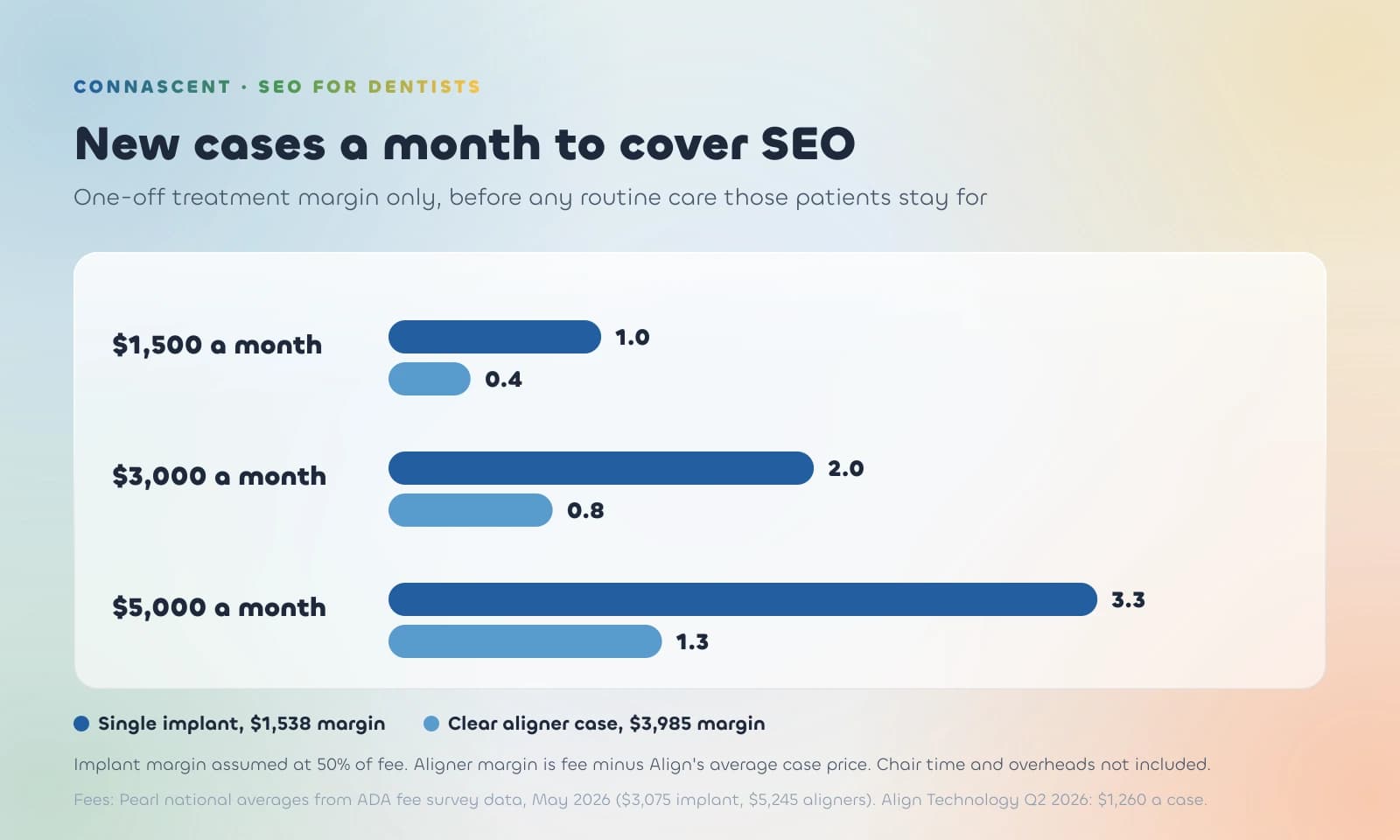
At $3,000 a month, SEO pays for itself at two implant cases or one aligner case a month. That ignores everything else those patients bring: hygiene visits, crowns and their families. Judge it at six months, with call and booking tracking set up from day one.
E-E-A-T for dentists: credentials are ranking signals
Google holds health pages to a higher standard of experience, expertise and trust. A licensed dentist already has the proof. Most practice websites just don't show it.
Dentist pages that show licences and credentials
One page per dentist with their DDS or DMD, state licence number linked to the board's public lookup, residencies, board certifications and the CE behind each treatment you offer. That page does more for your implant rankings than another "5 tips for whiter teeth" post.
Specialty advertising rules
Each state dental board sets its own rules. Some reserve "specialist" for recognised specialties and require a general dentist advertising specialty services such as orthodontics to say they are a general dentist (Oregon's rule is an example). Implant dentistry isn't on Oregon's list of specialties at all. "Experienced in implant dentistry" is safe. "Implant specialist" may not be. Check your board before your agency writes your headings.
Reviews: what helps rankings and what gets you fined
The FTC fake-reviews rule
Since 21 October 2024, the FTC's rule on consumer reviews bans fake reviews, paying for positive ones and suppressing negative ones, with civil penalties of up to $53,088 per violation. The FTC sent warning letters to 10 companies in December 2025. Ask every patient. Don't filter who you ask.
HIPAA and replying to reviews
Reply to every review, but never confirm the reviewer is a patient or mention their treatment. A California practice paid $23,000 to HHS after replying to Yelp reviews with patient details. "Thank you for your feedback, please call the office so we can help" is enough.
The dental SEO advice we'd ignore
- A page for every suburb within 30 miles. Near-identical location pages for places you don't operate get ignored. One strong page per real office does more.
- Blogging three times a week. One treatment page that ranks beats fifty generic posts.
- Guaranteed number-one rankings. Nobody controls Google. Walk away.
An SEO strategy for dentists: the first 90 days
Step 1: Google Business Profile
Primary category "Dentist", secondary categories for what you actually offer, every treatment listed as a service, real photos of your team and rooms, and a review routine. Most new-patient calls start here; our Maps ranking guide has the detail.
Step 2: One page per treatment
Implants, All-on-4, Invisalign, veneers, emergency care. Each page covers who it suits, how it works, price ranges, financing and who does it. They need writing for search and for patients at the same time, with the on-page basics right: one treatment per page, the treatment and city in the title.
Step 3: Dentist, insurance and financing pages
A page per dentist, a page per insurance network you're in, and a plain financing page. These are the questions patients ask on the phone. Answer them on the site and the phone rings with better-qualified patients.
Step 4: Citations and technical basics
Healthgrades, Zocdoc, Yelp, your insurers' directories and local press, with identical name, address and phone: the local end of link building. Then the technical basics and a fast mobile site with online booking that works.
No separate "AI SEO" is needed: Google says there are no extra requirements for AI Overviews, so the pages that rank are the ones AI answers cite.
SEO vs Google Ads for dentists
When Google Ads makes sense
Emergency dentistry, a new office, or an empty diary next month. Ads are the only channel that works this week. If you run them, manage them tightly: exact-match treatment terms, call tracking, and no broad match on "dentist".
When SEO comes first
If elective treatment is where your margin is and you're paying $15 or more for every implant click. Every month you wait, the practice above you on the map keeps those patients for free.
When SEO isn't worth it for a dental practice yet
Wait if
- You're fully booked with a waitlist and not adding a dentist or a hygienist.
- You're moving or rebranding within six months. A new name or address resets the local work.
- You're a DSO-affiliated office whose group runs marketing centrally. Ask what's already being done first.
- You need patients this month. Run ads first and start SEO alongside.
Don't wait if
- You have open chairs and want more implant, aligner or cosmetic cases.
- Patients find you by name, but you're missing from treatment searches in your town.
- You're paying for ad clicks on searches you could rank for.
Our verdict on SEO for dentists
Yes, if you have capacity and want more elective work. The clicks are expensive, the rankings are within reach, and the break-even point is one or two cases a month. Few local businesses get odds this good.
Want to know where your practice ranks now and which treatment searches you're missing? That's where our local SEO work starts. Ask for a free estimate.
Also in this series: should aesthetic clinics invest in SEO?