The Rundown
- ChatGPT reaches 900M weekly users and Google AI Overviews appear in 18% of searches. The AI is now the answer engine your buyers consult first.
- Click-through to traditional results halves (15% to 8%) when an AI summary appears; being inside the answer matters more than ranking below it.
- AI summaries are multi-source by design: 88% cite three or more sources, so the goal is to be one of the brands cited, not just the one ranked first.
- Modern AI assistants use Retrieval-Augmented Generation (RAG) and reward entity clarity, claim density, citation worthiness, and independent corroboration.
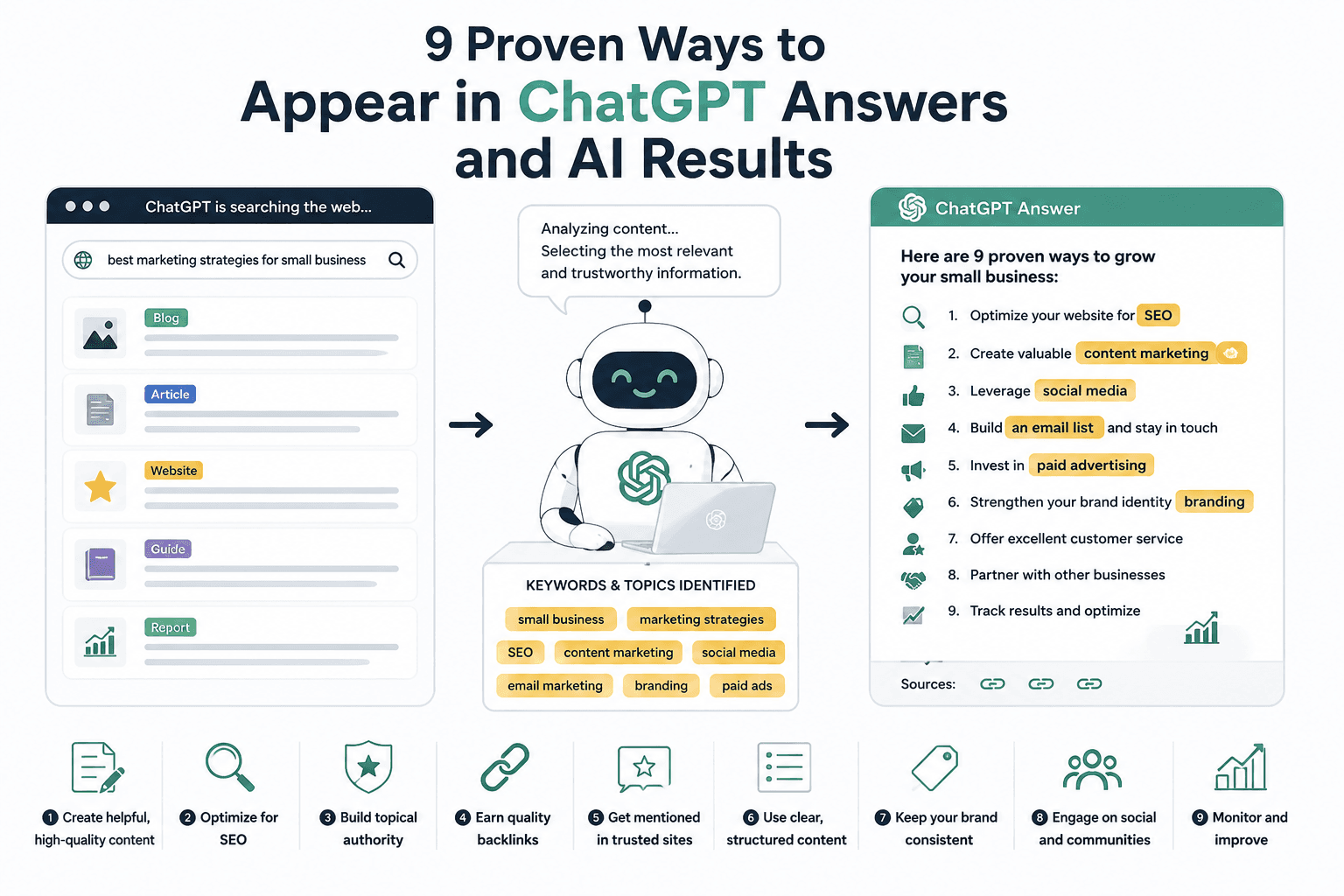
- The 9 strategies move from on-site foundations (entity coherence, answer-first writing, extraction-friendly structure, topical clusters) outward to off-site signals (brand mentions, reviews, niche directories, local SEO, digital PR).
- Entity coherence, meaning describing your brand the same way everywhere, is the unglamorous but highest-leverage foundation.
- Lead with the answer in every section: AI extractors lift the first sentence, so handing them a citable claim on a plate is the biggest content change most businesses need to make.
- Measure AI visibility by tracking weekly prompt mentions across ChatGPT, Perplexity, Gemini, and Claude, plus AI referrer traffic and citation patterns, not just SERP rank.
A buyer no longer types a question into Google and clicks the third result. They ask ChatGPT, scan the AI Overview that Google placed above the blue links, or read what Perplexity pulled from across the web, and they decide. ChatGPT alone reached 900 million weekly active users by February 2026, and a Pew Research study of 68,879 Google searches found that 18% of them already trigger an AI summary. If your brand is not in those answers, you are not in the conversation.
The harder truth: ranking on page one is not the same as being cited by AI. The Pew study found that when an AI summary appears, the click-through rate to traditional results drops from 15% to 8%, nearly cut in half. Position one still matters, but it now feeds an answer engine that decides whether your business gets mentioned at all. This article walks through nine concrete strategies to build the signals AI systems actually use to choose sources, grounded in what we know about how these systems retrieve and synthesize information.
The New Click Math: Why AI Visibility Matters More Than Position One
Three numbers explain the shift. First, AI summaries are multi-source by design: 88% of Google's AI summaries cite three or more sources, and only 1% cite a single source. The old SEO question ("how do I beat my competitor for the top spot?") has been replaced by a new one: "how do I become one of the three to five brands the AI cites?"
Second, AI summaries shorten user journeys. The same Pew study found that 26% of search sessions ended on a page with an AI summary, compared to 16% on pages with only traditional results. Users get their answer and leave. The brands mentioned inside that answer get the awareness; the brands ranking #2 through #10 below it often get nothing.
Third, this is happening everywhere. Google AI Overviews launched in the United States in May 2024 and expanded to more than 100 additional countries by October 2024. ChatGPT added live web search between late 2024 and early 2025. Perplexity, Claude, and Gemini all built citation-aware retrieval into their core products. The change is not coming. It is here.
Click-Through Rate With vs. Without an AI Summary
The strategic implication is uncomfortable for businesses that built their digital presence around traditional SEO alone: the work that wins page one is necessary but no longer sufficient. To appear in AI answers you also have to be findable, verifiable, and trusted across the web in a way AI systems can recognize.
How AI Assistants Actually Pick Their Sources
Before the nine strategies, it helps to understand the mechanism. Modern AI assistants do not "rank" pages the way Google has for two decades. They use Retrieval-Augmented Generation, or RAG: a three-step process where the system retrieves relevant documents from the live web, augments the user's question with that retrieved content, and then generates an answer. The retrieved sources are typically cited inline.
What does the retrieval step actually favor? Researchers studying this question coined the term Generative Engine Optimization (GEO) in a 2024 paper by Aggarwal, Murahari, and Rajpurohit. Their work and subsequent industry analysis converge on a short list of factors AI retrievers reward:
- Entity clarity. Can the system reliably identify what and who the page is about?
- Claim density. Does the page lead with direct, factual claims that can be lifted into an answer?
- Citation worthiness. Does the source look authoritative, with statistics, references, and named experts?
- Independent corroboration. Do other reputable sites describe the brand the same way?
That last factor is why brand mentions on third-party sites matter so much. The AI is not just reading your page; it is checking whether the broader web agrees with what your page says about you. If you describe yourself one way and the web describes you another way, the AI defaults to the version it can corroborate.
With that mechanism in mind, here are the nine strategies that move the needle, grouped from on-site foundations outward to the off-site web.
1. Build a Coherent Entity Across the Web
AI systems model brands as entities: a single conceptual record that ties together your name, what you do, where you operate, who runs you, and what you are known for. The cleaner that entity, the easier it is for an AI to identify you when someone asks a question your business should answer.
Entity coherence breaks when your service page says "digital marketing agency," your Google Business Profile says "marketing consultant," your LinkedIn says "growth agency," and a press mention calls you a "creative studio." Each of those descriptions is fine in isolation. Together, they make it harder for an AI to confidently say "yes, this company is the answer to that question."
The fix is unglamorous: write one short, factual description of who you are and what you do, and use the same one on your homepage schema, your About page, your Google Business Profile, your social profiles, and the boilerplate you send to journalists. Add structured data (Organization, LocalBusiness, or the appropriate subtype) so the description is machine-readable, not just visible to humans.
Strong entity authority builds on the same foundation as traditional search engine optimization, but it leans harder on consistency than on volume. Two clean, matching descriptions across the web do more than ten contradictory ones. The same logic extends to your underlying infrastructure: a fast, well-structured site built with proper custom website development practices makes it dramatically easier for AI crawlers to confirm what your entity is and what it does.
2. Lead With the Answer, Not the Setup
AI retrievers extract sentences, not articles. When the system grabs a passage from your page to support an answer, it usually grabs the first sentence or two of a section that matches the user's question. If those sentences set up the topic instead of answering it, you do not get cited; the model picks a competitor whose first line was the answer.
This is the single biggest content change most businesses need to make. Compare:
Buried answer. "Many small businesses wonder whether SEO is still worth the investment in 2026, given the rise of AI search and shifting consumer behavior. In this article, we'll explore the various factors..."
Answer-first. "SEO is still worth the investment for most small businesses in 2026, because organic traffic remains the largest single source of high-intent visitors for service-based companies and AI assistants disproportionately cite well-optimized pages."
The first version makes the AI work to extract a useful statement. The second hands it a citable claim on a plate. Open every section with a sentence that could stand alone as the answer. Then expand. Our existing post on how AI is transforming business visibility covers the underlying mechanics in more depth.
3. Structure Content So AI Can Extract It Cleanly
Substance still wins, but presentation decides whether the substance ever surfaces. AI retrievers parse pages much faster and more reliably when the structural cues are clean:
- A single, descriptive H1 that names the topic. No clever wordplay if the topic is not obvious.
- H2 and H3 headings phrased like questions or definitive statements. "Why AI Overviews are different" works; "Going beyond the old rules" does not.
- Short paragraphs (three to five sentences). Long blocks discourage extraction.
- Lists and tables for any enumerated or comparable content. Tables in particular are heavily favored by AI extractors because the row/column structure makes the relationships explicit.
- FAQ sections with real FAQPage schema markup. This is one of the highest-ROI technical SEO investments for AI visibility.
- Consistent terminology. If you call it a "free consultation" on one page, do not call it a "no-obligation review" on another. AI systems treat synonym drift as ambiguity.
This is the same hierarchy of clarity that helps a human skimmer find the answer in fifteen seconds. AI extractors reward the same patterns. If your site has accumulated layers of inconsistent templates over the years, our piece on whether websites are still worth investing in for 2026 covers how to think about the underlying rebuild decision.
4. Build Topical Clusters Around Your Services
A single great page can be cited. A cluster of well-linked pages on a topic gets cited far more often, because the AI sees a brand that demonstrates depth, not a one-off post. The cluster pattern is straightforward: one comprehensive pillar page on a core service, plus a constellation of supporting posts that each tackle a specific question, comparison, or use case in that topic.
For a marketing agency, the SEO cluster might look like:
- Pillar: a service page on on-page SEO
- Supporting: comparison posts (SEO vs. PPC, SEO vs. AI search), tactical guides (technical SEO audit, on-page optimization, link building), industry-specific takes (SEO for plumbers, dentists, law firms), and trend pieces (AI search, voice search, zero-click).
Each supporting page links up to the pillar and across to siblings where the topic naturally overlaps. The result is dense, navigable topical coverage that signals "this brand is a definitive source on this subject." AI systems pick that signal up across multiple queries, not just the one each page targets directly. This approach also strengthens traditional SEO content writing outcomes, so the investment pays out twice. For e-commerce brands, the same cluster logic applies to product categories and supports stronger ecommerce development outcomes when category pages, buying guides, and comparison content reinforce each other.
5. Earn Brand Mentions on Independent Sites
This is the leverage point most businesses underinvest in. An AI does not just read your website to learn about you; it cross-checks. When your brand appears across editorial articles, listicles, podcast show notes, industry roundups, partner case studies, and news coverage, the AI has multiple independent signals that you exist, that you operate in your stated category, and that other people consider you worth mentioning.
Three patterns of mention carry the most weight:
Category-association mentions
Being named in articles like "best [your category] in [your market]" or "tools we use for [problem you solve]." These are explicit signals that connect your brand to the queries you want to win.
Expert-quote mentions
Being quoted by name in industry articles, with a sentence or two of substantive commentary. Quoted experts get cited disproportionately because the surrounding article context tells the AI you are an authority on the topic.
Data-citation mentions
Other sites linking to original research, benchmarks, or data you published. This is the highest-leverage form of brand mention because every citing site is essentially endorsing your authority on the subject.
You can earn these mentions through pitching, contributing to roundups, publishing genuinely original data, building partnerships that produce co-marketing content, and responding to journalist queries through platforms like Help a B2B Writer and Featured. None of these are quick wins. But each mention compounds, because the AI keeps re-reading the web.
6. Show Up on the Review Platforms AI Trusts
AI systems treat established review platforms as high-trust validators. The reason is structural: review platforms aggregate independent customer voices, enforce some level of moderation, and use consistent, machine-readable schemas. When an AI is asked "what are the best agencies for X?", it checks G2, Capterra, Clutch, TrustRadius, and Google Reviews in addition to the agencies' own websites.
The minimum bar:
- A complete profile on each platform that matters in your category. For B2B services, that is typically Clutch, G2, and the category-specific options. For local businesses, Google, Yelp, BBB, and any industry-specific equivalent.
- A steady cadence of recent reviews. A profile with 80 reviews from 2022 and three from 2026 is a weaker signal than one with 30 reviews evenly distributed across recent months.
- Owner responses to reviews, especially the critical ones. Response activity is itself a signal of an active, accountable business.
- Service descriptions that match what your own site says. Same entity rules apply: drift between your site and your Clutch profile creates ambiguity.
Reviews are also one of the few off-site signals you can directly influence in the short term, by asking happy customers at the right moment and making the review process frictionless. For service businesses, the review platforms tie directly into off-page link and reputation signals: the same reviews that influence AI citations also feed Google Business Profile rankings.
7. Use Niche and Industry Directories Selectively
Niche directories rarely send much referral traffic, which is why most businesses ignore them. They matter for AI visibility for a different reason: a niche directory specifically confirms that your business belongs in a category. When an industry association, a software marketplace, or a vertical-specific directory lists you under a clearly labeled category, the AI gets a strong taxonomy signal it can use.
Be selective. The goal is not "submit to every directory." It is to find the three to ten directories that are indexed by Google, well-regarded in your specific industry, and likely to be referenced when an AI is trying to verify a category claim. A good rule of thumb: if a serious buyer in your industry would consult that directory, an AI almost certainly will too.
Avoid the inverse: generic spammy submission directories. Inclusion in low-quality directories does not help AI visibility and can actively harm it if the directories also signal low domain authority back into your link profile.
8. Strengthen Local SEO Even for National Brands
For a service business, local SEO is the most concentrated set of trust signals available. A complete, verified Google Business Profile, consistent NAP (name, address, phone) data across directories, location-specific landing pages, and a steady stream of geo-tagged reviews together establish that your business is real, operating, and trusted by real customers in a specific place.
Most local businesses already know this; the SEO benefits for small businesses have always been concentrated in local signals. The non-obvious part: even national or remote-first brands benefit from local SEO signals, because those signals are some of the easiest ways for an AI to verify entity legitimacy. A confirmed physical address on Google Business Profile and Bing Places, even for a brand that operates nationally, gives the AI a concrete, structured anchor to attach to the entity.
For location-dependent queries like "best [service] near me" or "[service] in [city]," local signals are decisive. AI Overviews increasingly rely on Google Business Profile and Maps data to populate local answers. Our dedicated guide on how to rank higher on Google Maps in 2026 covers the specific factors and how they are evolving as AI Overviews reshape local search.
9. Invest in Digital PR and Distribution Partnerships
The previous strategies build a foundation. Digital PR and distribution partnerships are how you accelerate the rate at which the web confirms your brand. The goal is to multiply the number of credible places where your brand is mentioned in the context of topics you want to win.
The highest-leverage digital PR activities for AI visibility:
- Original research and data studies. Publishing a survey of your industry, benchmark numbers from your customer base, or original analysis gives journalists something to cite by name. Cited data studies create a cascade of brand mentions across an industry.
- Expert commentary on news cycles. When something happens in your industry, a quick, substantive comment to journalists covering it can put your brand in mainstream coverage within hours.
- Co-marketing with adjacent partners. Joint webinars, joint research, and partner case studies create mutual mentions on each other's sites and across third-party coverage of the partnership.
- Strategic guest contributions. A small number of well-placed bylines in publications your buyers and AI systems read is worth far more than mass guest-posting in low-authority outlets.
Distribution partnerships extend the same idea: syndication agreements, content licensing, and inclusion in partner newsletters create more entry points where your brand is associated with your topics in a credible context. The same audience-amplification logic applies on paid channels. When you run Google Ads or Facebook campaigns, the branded impressions create downstream search demand that AI systems eventually pick up as repeated brand-topic associations. Our 2026 guide to leveraging PPC advertising covers how to set up paid programs that compound this branded-search effect rather than fight it.
What AI Visibility Looks Like When You Measure It
Traditional rank tracking will not tell you whether you are appearing in ChatGPT. The measurement stack is still maturing, but three practical approaches give you signal today:
Prompt monitoring
Maintain a list of 20 to 50 prompts your buyers would plausibly ask an AI assistant: questions about your category, comparisons, "best X" queries, problem-statement queries. Run them weekly across ChatGPT, Perplexity, Gemini, and Claude. Track whether your brand is mentioned, how it is described, and which competitors appear. This is manual but produces the most direct signal.
Referral analytics
Check your analytics for traffic with referrer domains like chat.openai.com, perplexity.ai, and gemini.google.com. These referrals indicate users clicked through from an AI citation. Growth in this segment is direct evidence of citation frequency, though not all AI citations produce clicks (only 1% of users click links inside Google AI summaries, so traffic is only a partial signal).
Citation pattern analysis
When you do find your brand cited, note which pages get cited, for which prompts, and what surrounding context. This guides where to invest more content depth.
Specialized AI visibility tools have started appearing: Profound, Otterly.AI, and Peec.ai are three of them. They automate prompt-monitoring at scale. They are early-stage but useful for businesses that want to move past spot-checking.
Where to Start
You do not implement nine strategies in a week. The realistic sequence:
-
First two weeks. Audit entity consistency across your site, Google Business Profile, social profiles, and any directory listings. Pick one canonical description and align everything to it. Fix obvious schema gaps (Organization, LocalBusiness, FAQPage where relevant). If you want a structured starting point, our digital marketing services page lists the audits we typically run before any of this work begins.
-
Weeks three to six. Rewrite your most important service and pillar pages with answer-first openings, clean heading hierarchy, and FAQ sections. This is the on-site work that has the largest direct impact on extractability.
-
Months two and three. Build out the topical cluster around your highest-priority service. Identify the ten to fifteen supporting posts that should exist and prioritize the gaps. Start a steady cadence of new mentions through review-platform optimization and outreach.
-
Months three to six. Layer in digital PR: original research, expert positioning, co-marketing with adjacent partners. By this stage your on-site foundation is doing the heavy lifting, and off-site signals start compounding.
Skipping the foundation work to chase PR rarely works. The mentions arrive but the AI cannot connect them to a coherent entity, and the visibility lift is muted.
The Bottom Line
The brands that win AI visibility in 2026 are not the ones with the most content or the biggest ad budgets. They are the ones the web describes consistently, that publish answer-first content structured for extraction, and that have built up enough independent corroboration across reviews, directories, partners, and press that an AI can confidently say "yes, this business is the answer."
That work overlaps heavily with the SEO and content fundamentals that have always mattered. The difference is the unit of success has changed: from "rank a page" to "be the brand the AI cites." If you want to talk through where your business stands today and where the highest-leverage gaps are, contact our team for a free consultation. Our guides on GPT-5.3 vs Claude Opus 4.6, agentic AI in 2026, the operations gap behind AI agents, ChatGPT ads in 2026, and choosing the right AI assistant cover the surrounding context in more depth.
The conversations are happening with or without you. The question is whether your brand is one of the names that comes up.