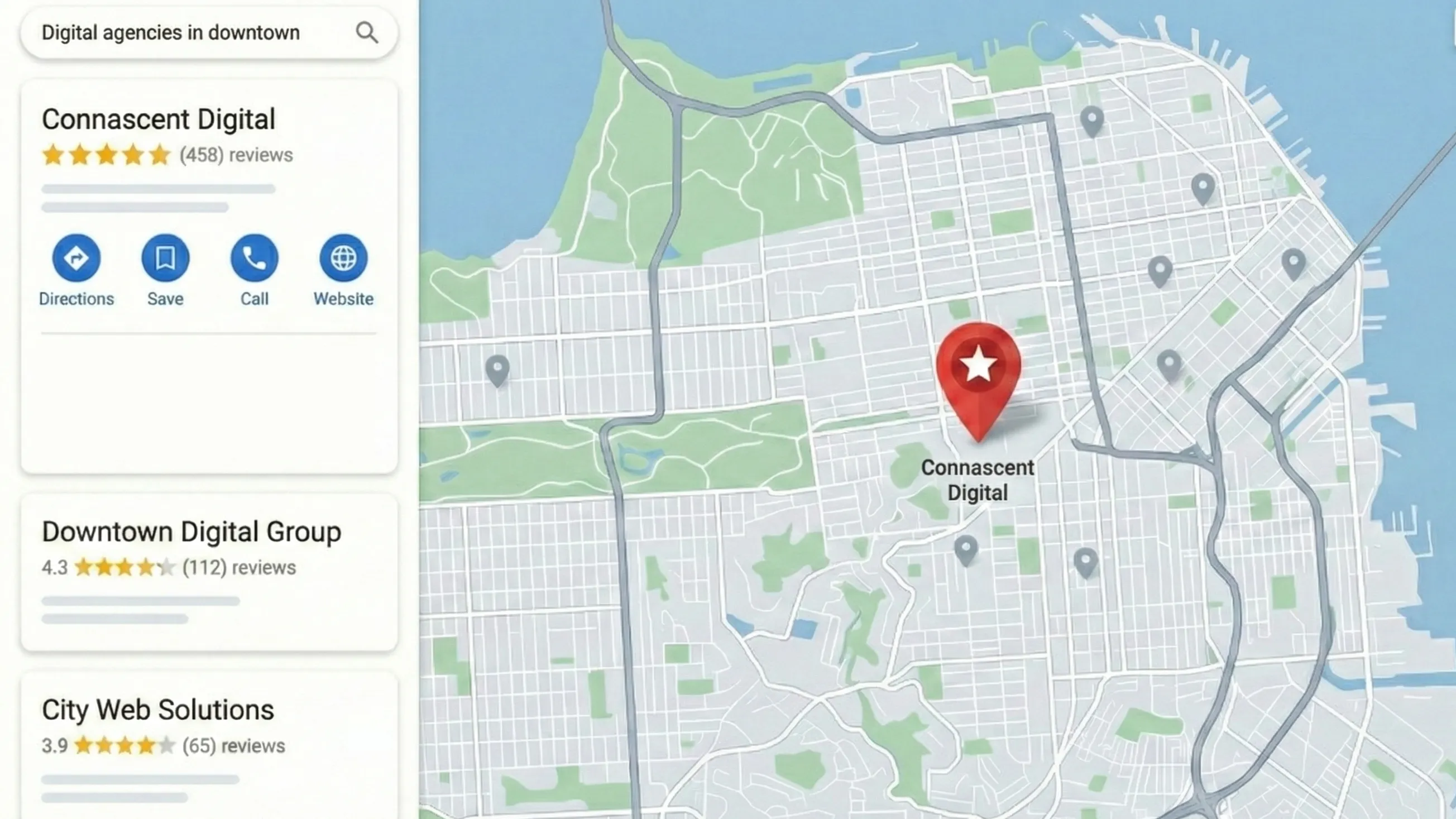
Most Google Business Profile guides tell you to optimize everything. Fill out every field. Post every week. Geotag your photos. Respond to every review with a novel.
The data says otherwise. Darren Shaw, founder of Whitespark and a recognized authority in local search, has been surveying local SEO practitioners since 2008 to identify what actually moves the needle. Whitespark's 2026 Local Search Ranking Factors survey shows that a handful of signals drive the vast majority of local pack visibility, while several commonly recommended tactics have little to no ranking impact.
Here is what works, what does not, and how Google's AI-driven search is reshaping local visibility.
How Google Ranks Local Results
Google uses three pillars for local rankings.
You cannot change your location, but you have full control over relevance and significant control over prominence.
9 Ranking Factors That Work
Ordered by influence based on Whitespark's scoring data and Localo's SERP analysis.
1. Primary Business Category (Score: 193)
The single most influential local pack signal. Your primary category tells Google what your business is. Getting it wrong is equally damaging — incorrect primary category scores 176 as a negative factor.
Pick the most precise match. "Pizza Restaurant" over "Restaurant." "Internet Marketing Service" over "Marketing Agency."
Action: Search your main keywords on Google Maps. Check what primary category the top 3 results use. Match accordingly.
2. Keywords in Business Name (Score: 181)
"Joe's Plumbing" naturally outranks "Joe's Services LLC" for plumbing searches. If keywords appear in your legal business name, you get a built-in advantage.
Do not stuff keywords into your GBP name. Google suspends profiles for it. Your name must match your real, registered business name.
Action: If your name lacks keywords, make up for it by excelling in the other 8 factors.
3. Physical Address in Search City (Score: 170)
A verified physical address within the searched city is the third strongest signal, tied directly to proximity.
Action: Verify your address is accurate. If you serve multiple cities, evaluate whether a physical presence in those markets makes business sense.
4. Reviews: Quantity, Quality, and Velocity
The most actionable factor on this list.
Average Review Count by SERP Position
Top 3 positions average over 200 reviews. But total count alone is not enough — Google weighs review velocity, how consistently new reviews come in. Five reviews per week beats a burst of 50 followed by silence.
Localo's analysis also found that top 3 businesses receive reviews averaging 350 words versus 300 words for lower-ranked competitors. Longer reviews signal real engagement.
Action: Create a systematic review request process. Ask every customer. Share a direct review link. Prioritize steady flow over volume spikes. If you run Google Ads or Facebook advertising, follow up with paying customers — they convert to reviewers at a higher rate.
5. High Numerical Ratings (Score: 138)
Star ratings affect both rankings and whether someone clicks your listing. This is the top conversion factor at a score of 177.
87% of consumers use Google to evaluate local businesses. Star ratings are the first thing they check.
Action: Respond to negative reviews quickly and professionally. A 4.5-star business with thoughtful responses outperforms a 5-star business with none.
6. Review Responses
How you reply impacts ranking. The data shows a clear correlation between response length and position:
Top-ranking businesses write responses roughly 40% longer than lower-ranked competitors — not "Thanks for your review!" templates, but replies that reference specifics and address concerns.
Action: Respond to every review. Mention something the customer said. Aim for 100 to 150 words.
7. Additional Business Categories (Score: 134)
Secondary categories expand which searches you appear in. You can add up to 10, and relevant additions can produce immediate ranking gains.
Action: Check your competitors' categories. Add every one that legitimately describes your business. A web design company might add "Website Designer," "Internet Marketing Service," "Software Company," and "Graphic Designer."
8. Photos and Visual Content
Google confirms profiles with photos receive more engagement, and engagement drives rankings. The correlation:
Average Photo Count by SERP Position
Businesses that go 30+ days without a new photo see measurable impression drops.
Action: Upload real photos of your business, team, and work. At least one new photo per week. Authentic beats stock every time. If you sell products online, your e-commerce store product photos can double as GBP content.
9. Hours of Operation
Rankings shift depending on whether your business is open at the time of the search. Google deprioritizes closed businesses in local results.
Action: Keep hours accurate. Set special hours for holidays. Extended hours compared to competitors give you a ranking edge during off-peak times.
9 Factors You Can Skip
These features help conversions and customer experience, but have minimal to no direct ranking impact.
These features do not control whether you appear in results. They influence whether someone clicks once you do. Do them for conversion, not ranking.
AI Overviews and Local Search
Google's AI Overviews — powered by Gemini — now serve as a primary entry point for local queries. Instead of just the local 3-pack, Google synthesizes GBP data, reviews, and website content into AI-generated summaries.
This changes several things.
AI Uses Your Full Profile
Traditional local pack ranking runs on categories, proximity, and reviews. AI Overviews pull from everything — descriptions, Q&A answers, review text, website copy, Google Posts.
Those "no ranking impact" features from the table above? They now feed AI visibility, even if they still do not move your local pack position.
AI Extracts Review Details
AI Overviews do not just count reviews. They extract specifics — what customers liked, common complaints, services mentioned, sentiment patterns.
"Best pizza in Brooklyn, the margherita is incredible and they deliver in under 30 minutes" gives the AI far more signal than "5 stars, great place."
Action: Encourage customers to mention what they bought, what stood out, and why they would recommend you.
Your Website Feeds AI Visibility
Google's AI crawls and synthesizes your website to understand your business. SEO content writing and on-page optimization now directly feed local visibility.
Detailed service pages, location-specific content, and well-structured information all give the AI more to work with. A well-built custom website with proper technical SEO gives your GBP listing a stronger foundation than a template site with thin content.
Fresh Profiles Rank Better
Reports show that businesses not posting updates or photos for 30+ days see impression drops. Google's algorithm now weighs profile activity more heavily — a newer business with high GBP engagement can outrank an established competitor with stronger domain authority but a stale profile. Regular website maintenance and GBP updates go hand in hand.
Ranking Signal Weights
How much each signal category contributes to local pack rankings:
Local Pack Ranking Signal Weights (Whitespark 2026)
GBP signals account for 32% of local pack rankings. Combined with review signals (16%), nearly half the algorithm is controlled by your profile and customer feedback. Agentic AI tools are starting to automate parts of this — from review monitoring to GBP post scheduling.
On-page signals (19%) represent your website — page titles, content, structure. Search engine optimization directly supports local rankings. Our guide on how AI is transforming business visibility covers the website side.
Local 3-Pack Click Rates
Click Distribution in Local Search Results
44% of local searchers click the local 3-pack — more than organic and paid combined. Businesses inside the pack receive 126% more traffic and 93% more conversion actions than those below it.
Position #1 gets 17.8% of clicks, #2 gets 15.4%, #3 gets 15.1%. The gap between positions is small. The gap between being in the pack and outside it is not. Pairing local pack visibility with PPC advertising covers both organic and paid slots on the same results page.
GBP Optimization Checklist
High priority (ranking impact):
- Set the most precise primary category for your business
- Verify your business name, address, and phone are accurate everywhere
- Build a process for earning reviews consistently
- Respond to every review with 100-150 word personalized replies
- Add all relevant secondary categories
- Upload fresh, authentic photos weekly
- Keep business hours current, including special hours
Medium priority (AI visibility + conversions):
- Write a keyword-rich business description
- Fill out all services with detailed descriptions
- Seed the Q&A section with real customer questions
- Post updates, offers, and news through Google Posts
- Add detailed service and location pages to your website
Supporting (indirect through website):
- Build quality local backlinks and citations
- Keep NAP consistent across all directories
- Optimize your site for speed and mobile
- Publish locally relevant blog content
Initial improvements typically show within 4 to 8 weeks. Meaningful ranking shifts take 3 to 6 months. Joy Hawkins, a prominent local SEO expert and owner of Sterling Sky, has found through extensive testing that businesses maintaining consistent optimization efforts over six or more months see compounding improvements in local pack visibility. Consistency separates businesses that briefly appear in the local pack from those that stay.
Get Started
GBP is not a set-and-forget listing. It is an active channel that needs the same attention as your website and social media. And if you're still weighing the broader investment, our breakdown of why SEO is worth it for small businesses covers the real costs, timelines, and the cases where it isn't.
If your local visibility needs work, or you want your digital presence optimized for both traditional search and AI Overviews, reach out for a free consultation. We build SEO strategies and web presence that drive local results.