On February 5, 2026, the two leading AI companies released their most powerful models within minutes of each other. Anthropic launched Claude Opus 4.6 with a 1 million token context window and multi-agent teams. OpenAI released GPT-5.3-Codex, the first AI model that helped build itself. Both claim to be the most capable AI coding model ever created.
For businesses, this simultaneous release signals something bigger than a spec sheet comparison. As Andrej Karpathy, former head of AI at Tesla and founding member of OpenAI, has observed, the pace of improvement in frontier models is compressing what used to take years of research into months. AI capabilities are advancing at a pace that creates real competitive advantages for companies paying attention and real risks for those that are not.
Here is what each model brings to the table, how they compare, and what it all means for your business.
What OpenAI Released: GPT-5.3-Codex
OpenAI describes GPT-5.3-Codex as their most capable agentic coding model to date. It combines the coding performance of GPT-5.2-Codex with the reasoning and professional knowledge of GPT-5.2, all in one model that runs 25% faster.
The headline feature is unprecedented: GPT-5.3-Codex is the first AI model that was instrumental in creating itself. The development team used early versions of the model to debug its own training, manage its own deployment, and diagnose test results. This recursive self-improvement marks a significant milestone in AI development.
Key GPT-5.3-Codex Features
Speed and efficiency. The model is 25% faster than GPT-5.2-Codex while achieving better results with fewer output tokens. For teams paying per token, this means lower costs per completed task.
Real-time interactivity. Unlike previous models that work silently until finished, GPT-5.3-Codex provides frequent updates on decisions and progress. Users can ask questions, discuss approaches, and steer the model toward solutions as it works.
Unified capabilities. Previous OpenAI models split coding and reasoning into separate models. GPT-5.3-Codex merges both into one, eliminating the need to switch between models for different tasks.
Availability. GPT-5.3-Codex launched across all Codex surfaces including the app, CLI, IDE extension, and web for paid ChatGPT plans. API access is planned but not yet live.
What Anthropic Released: Claude Opus 4.6
Anthropic's Claude Opus 4.6 is an upgrade to the Opus 4.5 model released in November. It brings a massive context window expansion, multi-agent coordination, doubled output capacity, and security capabilities that made headlines before the model even launched.
Key Claude Opus 4.6 Features
1 million token context window. Opus 4.6 can process up to 1 million tokens in a single prompt, available in beta. This is a 5x increase from the 200,000 token limit on Opus 4.5. For context, 1 million tokens is roughly equivalent to processing an entire codebase or thousands of pages of documents in a single conversation.
128K output tokens. The maximum output doubled from 64,000 to 128,000 tokens, enabling longer thinking budgets and more comprehensive responses for complex tasks.
Agent Teams. This is the standout new capability. Teams of AI agents can now split larger tasks into segmented jobs, with each agent owning its piece and coordinating directly with the others. Instead of one agent working through tasks sequentially, multiple agents work in parallel.
Adaptive Thinking. The model dynamically adjusts its reasoning depth based on task complexity, with four selectable intensity levels. Simple questions get quick answers. Complex problems get deep analysis.
Context Compaction. When the conversation fills up, the model automatically summarizes older segments to preserve the most relevant information, allowing extended work sessions without losing critical context.
500 zero-day vulnerabilities discovered. Before launch, Anthropic's red team tested Opus 4.6 in a sandboxed environment with access to security analysis tools but no specific instructions. The model independently found over 500 previously unknown high-severity security flaws in popular open-source libraries, including buffer overflow vulnerabilities in OpenSC and GhostScript.
Enterprise integrations. Claude Opus 4.6 can now work directly in Microsoft PowerPoint, reading existing layouts and generating slides that match your design. The model also handles messy Excel spreadsheets without needing explicit formatting explanations.
Pricing. API pricing remains at $5 per million input tokens and $25 per million output tokens for standard use. Prompts exceeding 200,000 tokens are charged at premium rates of $10 input and $37.50 output per million tokens.
Availability. Available immediately on claude.ai, the Claude API, GitHub Copilot, Microsoft Azure, and other major cloud platforms.
How They Compare: Benchmarks
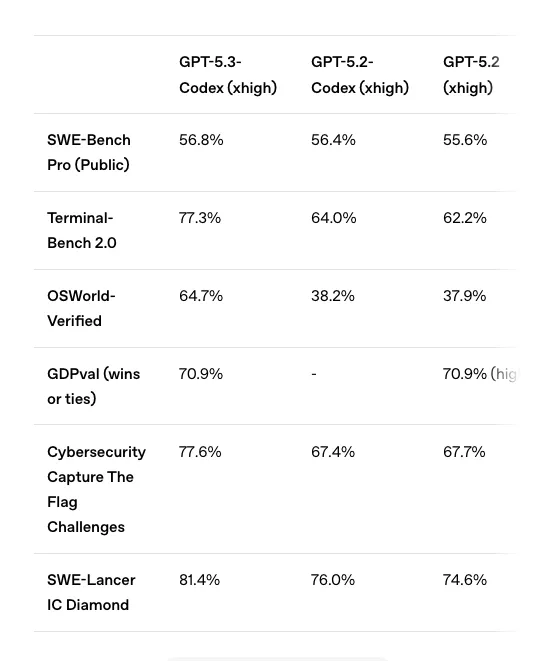
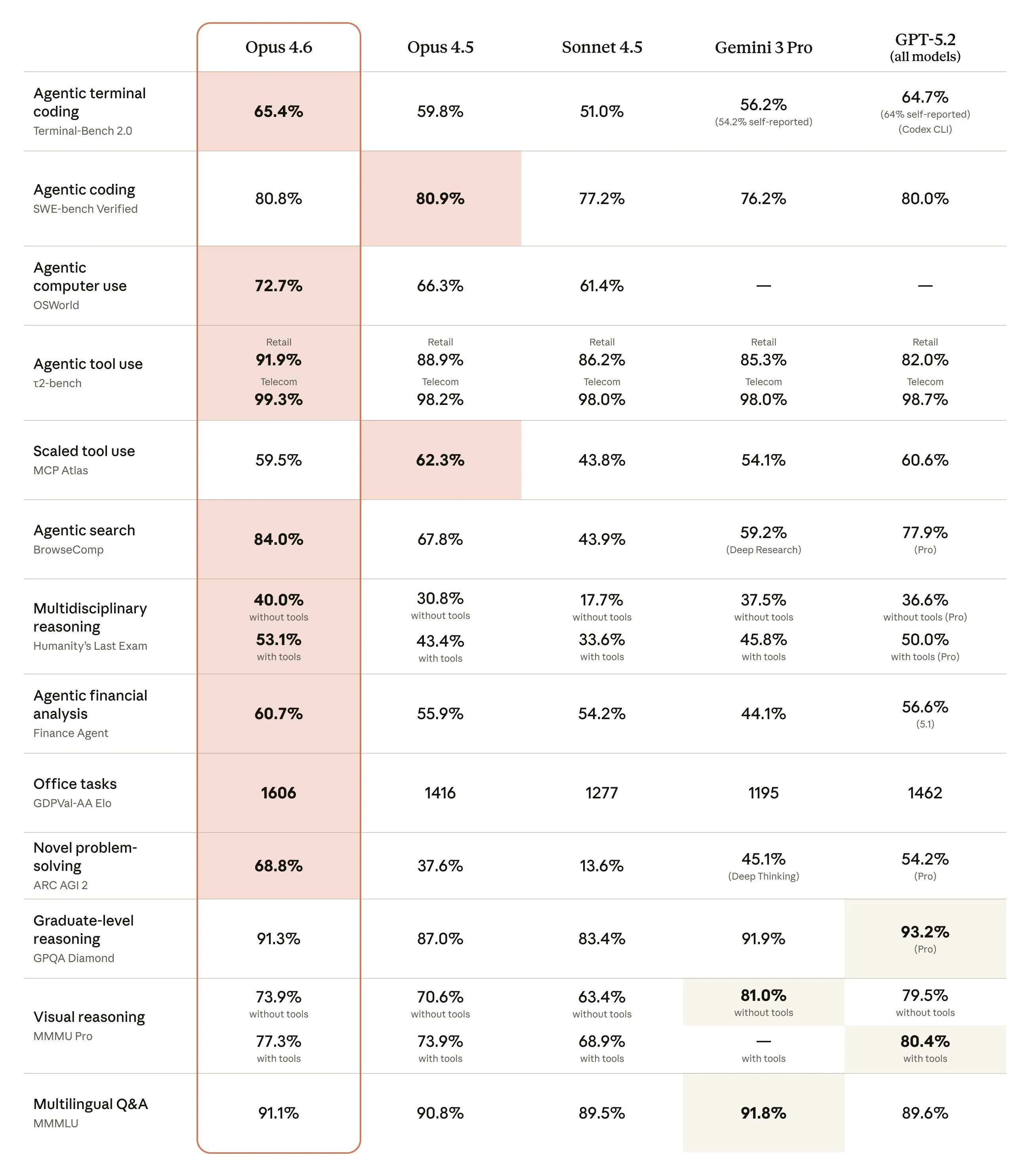
Both companies released benchmark scores. Here is how they stack up against each other and their predecessors.
Terminal-Bench 2.0 Scores (Higher is Better)
Benchmark data sourced from OpenAI's GPT-5.3-Codex announcement and Anthropic's Claude Opus 4.6 announcement.
The benchmarks tell a nuanced story. GPT-5.3-Codex dominates on coding-specific tasks, particularly Terminal-Bench 2.0 where it scored 77.3% compared to Opus 4.6's 65.4%. But Claude Opus 4.6 leads on economically valuable knowledge work, outperforming GPT-5.2 by 144 Elo points on GDPval-AA and leading all frontier models on Humanity's Last Exam.
Head-to-Head: Which Model Wins Where?
The answer depends entirely on what you need.
The Bigger Picture: What This Means for Business
This simultaneous release is not just a coincidence. It signals several important trends that directly impact how businesses should think about AI.
AI Coding Is Approaching Human-Level Performance
GPT-5.3-Codex scores 64.7% on OSWorld-Verified, approaching the roughly 72% human baseline. Claude Opus 4.6 found 500 security vulnerabilities that human researchers missed. These are not tools that help developers write code faster. They are systems that can independently find and fix problems in complex software.
For businesses investing in web development or custom website development, this means development timelines will continue to compress. AI-assisted development is becoming AI-driven development.
The Context Window Race Changes Everything
Claude Opus 4.6's jump to 1 million tokens means an AI can now read and reason about an entire codebase, a full legal contract library, or years of financial records in a single conversation. On the MRCR v2 benchmark, it scores 93% accuracy at retrieving specific information from 256,000 tokens of context.
This has practical implications for businesses. An AI that can process your entire website, all your marketing materials, and your competitor analysis simultaneously will produce fundamentally better strategic recommendations than one working with fragments.
Multi-Agent AI Is Here
Claude Opus 4.6's Agent Teams feature represents the shift from single AI assistants to coordinated AI workforces. Instead of one agent handling a task from start to finish, multiple specialized agents can divide work, execute in parallel, and coordinate results.
This directly connects to the agentic AI revolution we wrote about. The tools for building AI-powered business workflows just got significantly more powerful.
Self-Improving AI Is No Longer Theoretical
GPT-5.3-Codex helped build itself. OpenAI used early versions to debug training, manage deployment, and diagnose evaluations. This is a milestone moment: AI systems contributing to their own development accelerates the pace of future improvements. Dario Amodei, CEO of Anthropic, has described this trajectory as a "compressed industrial revolution" where AI capabilities compound on themselves in increasingly shorter cycles.
For businesses, this means the AI capabilities available to you will improve faster than ever. Strategies built around current limitations may become obsolete sooner than expected.
Security Is Both a Capability and a Concern
Claude Opus 4.6 finding 500 zero-day vulnerabilities demonstrates that AI can now identify security flaws that traditional tools and human researchers miss. This is valuable for defense but also raises concerns about malicious use. Anthropic noted they added new security controls to prevent abuse of these capabilities.
For businesses managing websites and applications, AI-powered security auditing is becoming essential. Our website maintenance and support services increasingly incorporate AI-driven security monitoring.
What This Means for Your Digital Strategy
These releases have practical implications for how businesses approach their digital presence and marketing.
Content and SEO
AI models that understand context better produce better content recommendations. Claude Opus 4.6's ability to process 1 million tokens means AI tools can now analyze your entire content library, your competitors' content, and search trends simultaneously to identify genuine gaps and opportunities.
This makes SEO content writing more data-driven than ever. The businesses that leverage these capabilities for their search engine optimization strategy will produce more targeted, effective content. Our analysis of how AI is transforming business visibility explores this shift in depth.
Advertising and Campaign Management
AI models that reason better optimize campaigns better. Both GPT-5.3 and Claude Opus 4.6 show improved performance on tasks requiring complex multi-step reasoning, exactly the kind of thinking involved in campaign optimization.
For businesses running Google Ads or Facebook advertising, these models power the next generation of AI-driven campaign management tools that can analyze performance, identify patterns, and adjust strategies with greater accuracy.
Website Development
AI-driven development tools powered by these models will accelerate how quickly businesses can build, iterate, and improve their digital presence. GPT-5.3-Codex's real-time interactivity means developers can collaborate with AI in ways that feel more like working with a skilled colleague than issuing commands to a tool.
Whether you need e-commerce development, a WordPress site, or a custom web application, the development process is becoming faster and more capable with each model release.
How to Stay Ahead
The pace of AI releases is accelerating. Here is how to make sure these advances benefit your business rather than just your competitors.
Audit your current tools. If you are using AI in your business, check whether your tools have updated to these latest models. The performance gap between model generations is significant.
Invest in your digital foundation. AI tools are only as effective as the infrastructure they work with. A well-built website, clean data, and clear processes give AI systems the foundation to deliver real results. If your website needs an upgrade, now is the time.
Start experimenting. You do not need to overhaul everything overnight. Pick one area, such as content creation, campaign optimization, or development workflows, and test how these new models perform compared to what you are using now.
Work with partners who stay current. The AI landscape changes monthly. Working with a team that actively tracks and implements new capabilities ensures you benefit from advances without having to become an AI expert yourself.
What Comes Next
Both OpenAI and Anthropic are clearly racing toward increasingly capable AI systems. GPT-5.3's self-improvement capabilities and Claude Opus 4.6's multi-agent teams both point toward a future where AI handles more complex, multi-step business processes with less human intervention.
The businesses that position themselves now, with strong digital foundations, AI-literate teams, and strategic implementation, will capture the compounding advantages as these models continue to improve.
If you want to discuss how to leverage these latest AI capabilities for your business, contact our team for a free consultation. Whether it is optimizing your marketing, building a modern website, or developing an AI integration strategy, we help businesses turn AI advances into competitive advantages.
The AI race between OpenAI and Anthropic benefits everyone building a business online. The question is whether you are positioned to take advantage of it.