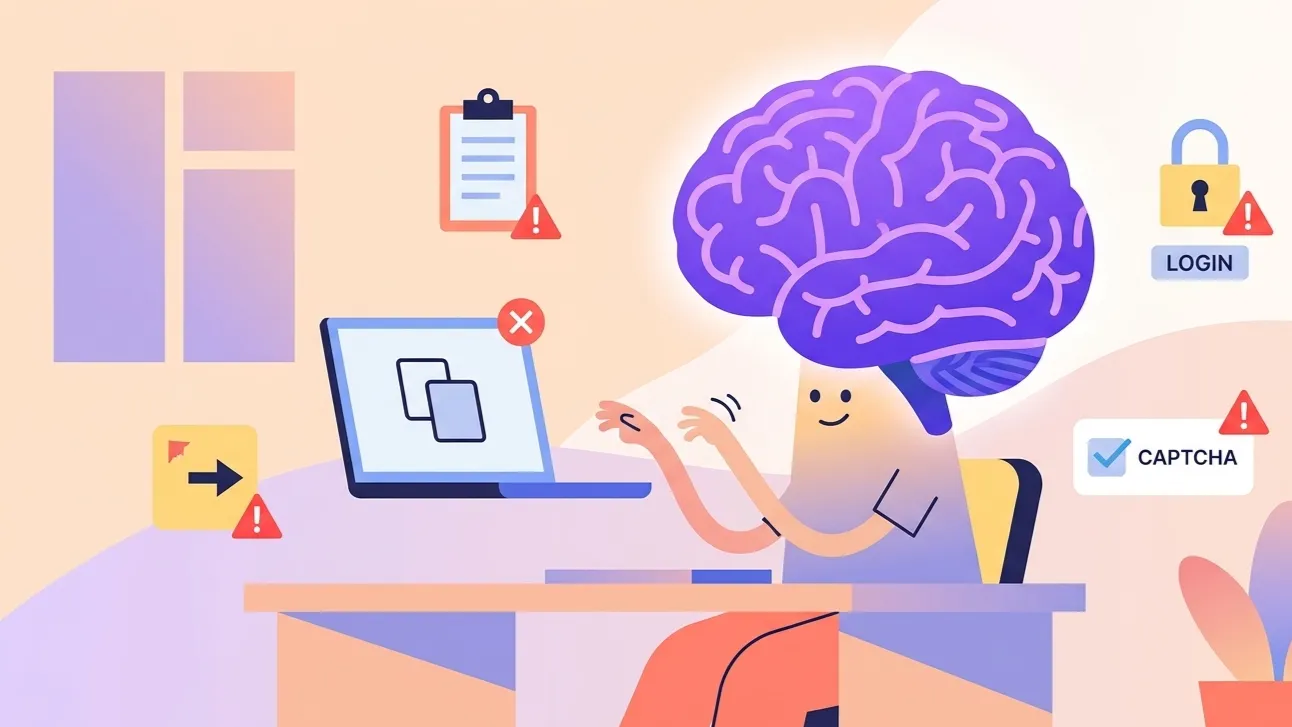
Something unusual is happening in enterprise technology. The largest companies in the world — Anthropic, OpenAI, Google, Microsoft, Amazon, and Meta — are collectively spending tens of billions of dollars on AI agents: software that can reason through complex problems, write production-grade code, and conduct multi-step research with minimal human supervision. The underlying models are extraordinary. Anthropic's Claude Opus 4.6 can maintain focus on a single engineering task for over fourteen hours. OpenAI's latest Codex model was instrumental in creating its own successor. Coding agents now author roughly four percent of all public code committed to GitHub.
And yet, ask any of these agents to copy a paragraph from a document, paste it into a web form, and click "Submit," and there is a reasonable chance it will fail.
This is not a marginal quirk. It is the central tension defining the current generation of AI agents — and for business leaders evaluating where to invest, it changes the calculus entirely. The question is no longer whether agents are intelligent enough. It is whether they can reliably perform the mundane, mechanical operations that constitute the vast majority of real computer work.
The State of Play: Every Major Company Has Shipped Agents
The agentic AI landscape has matured rapidly. As of early 2026, every major technology platform has released agent products, and the market has begun to consolidate through a series of high-profile acquisitions.
Anthropic has built the broadest toolkit. Claude Code, its terminal-native coding agent, reached general availability in May 2025 and contributed to a 4.5x revenue increase. The February 2026 release introduced Agent Teams — multiple sub-agents coordinating across parallel workstreams — and a dedicated code review system. Claude's Computer Use capability, launched in late 2024, allows the model to see and interact with desktop interfaces through screenshots and simulated mouse and keyboard actions. The Model Context Protocol (MCP), Anthropic's open standard for connecting AI to external tools, has been adopted across the industry, with over ten thousand active public servers and ninety-seven million monthly SDK downloads. In December 2025, Anthropic donated MCP to the Agentic AI Foundation under the Linux Foundation, with backing from Google, Microsoft, and AWS.
OpenAI has assembled a parallel stack. Operator, its browser-based agent launched in January 2025, was folded into ChatGPT Agent Mode by mid-year, combining web browsing with code execution and integrations to Gmail, GitHub, and Google Drive. The Codex coding agent has iterated to GPT-5.3-Codex, and over one million developers have used it. On the API side, OpenAI's Responses API and open-source Agents SDK provide the building blocks for custom agent development.
Google's approach is distributed across multiple products. Project Mariner handles browser automation. Jules, its coding agent, left beta in August 2025. Gemini Agent Mode, available to AI Ultra subscribers, orchestrates across Gmail, Calendar, Search, and Maps. Google also launched the Agent2Agent (A2A) protocol, an open standard for inter-agent communication, and the Agent Development Kit (ADK) for building custom agents on Vertex AI.
Microsoft embedded agents deeply into its enterprise suite. The March 2026 Copilot Wave 3 release introduced Copilot Cowork, built with Anthropic's Claude. GitHub Copilot's coding agent reached general availability for all paid plans, autonomously resolving assigned issues in background. Microsoft also merged its AutoGen and Semantic Kernel frameworks into a unified Agent Framework.
Amazon's AWS built the most infrastructure-focused offering, with Bedrock AgentCore providing managed services for agent deployment, and Q Developer achieving sixty-six percent on the SWE-bench coding benchmark. Meta acquired Manus AI for over two billion dollars in December 2025, signaling its intent to add autonomous agent capabilities across WhatsApp, Instagram, and Facebook. Apple remains the notable laggard, with promised agentic Siri features still unshipped nearly two years after their announcement and a major Google Gemini partnership expected to power its next-generation capabilities.
In the startup ecosystem, Cursor crossed one million users and a twenty-nine billion dollar valuation. Devin 2.0 slashed its price from five hundred to twenty dollars per month. Google executed a 2.4 billion dollar acqui-hire of Windsurf's founders, and Replit pivoted entirely to agent-first development. The era of standalone AI coding tools is giving way to platform consolidation.
The Paradox: Superhuman Reasoning, Subhuman Operations
The capability gap at the heart of AI agents is both striking and underappreciated. These systems can architect entire applications from a single prompt, refactor thousands of lines of legacy code, and reason through debugging chains that would occupy a senior engineer for an afternoon. They score near eighty percent on professional-grade software engineering benchmarks and can chain over twenty tool calls without human intervention.
But they cannot reliably do what a typical office worker does hundreds of times a day without thinking: copy text between applications, drag a file into an upload field, navigate a login screen, or dismiss a cookie banner.
This is not a matter of intelligence. It is a matter of infrastructure. AI agents operate one layer above the physical interfaces that humans use, and the bridges between reasoning and action are far more fragile than the reasoning itself.
Clipboard operations: the poster child
Copy and paste is arguably the single most frequently used computer operation in knowledge work. It is also largely broken for AI agents. Browser-based agents operate in sandboxed environments with no access to the system clipboard. Desktop agents can simulate keyboard shortcuts like Ctrl+C and Ctrl+V, but clipboard state is a shared, system-level resource that can be overwritten by any application at any time. There is no reliable way for an agent to verify that what it copied actually arrived at the destination. For a human, this operation is automatic. For an agent, it requires coordinating across operating system boundaries that were never designed to be programmatically accessible.
Drag and drop: nearly nonexistent
Drag-and-drop is one of the hardest GUI interactions for agents to perform. Research on Claude's Computer Use documented specific failures with click-and-drag operations in applications like PowerPoint. Most agent frameworks support only four basic actions: click, type, scroll, and observe via screenshot. Complex gestures such as dragging a file from a folder into a browser upload field, repositioning elements in a design tool, or reordering items in a list are either unsupported entirely or succeed so rarely as to be practically useless.
Authentication: the biggest single blocker
No production agent can reliably handle the login process for arbitrary websites and applications. CAPTCHAs are designed specifically to block automated access — OpenAI's Operator explicitly hands control to the human user when it encounters one. Two-factor authentication compounds the problem: there is no secure, automated way for an agent to receive and enter a one-time code from a phone or authenticator app without creating unacceptable security risks. Even basic OAuth flows require a server-side callback that most agent environments do not provide.
The scale of this problem prompted AWS to launch Web Bot Auth in 2026, a draft protocol that gives agents cryptographic identities to reduce CAPTCHA friction. The fact that a dedicated protocol was needed — and that it is still in draft — underscores how fundamental the gap remains.
UI interaction: death by a thousand paper cuts
Even when agents can see a screen and click on elements, the failure modes are pervasive. Modal overlays, cookie consent banners, loading spinners, infinite scroll, and dynamically rendered content all create scenarios where the agent's screenshot-based understanding of the interface does not match what a click will actually do. On the OSWorld benchmark, which tests real desktop tasks, Claude achieved only 14.9 percent success in screenshot-only mode. On WebArena, early GPT-4 agents completed only fourteen percent of web tasks that humans finished seventy-eight percent of the time.
AI Agent Success Rates on Real-World UI Tasks
The Math That Matters: Compound Failure Rates
The most important number in agentic AI is not any individual benchmark score. It is the compound reliability rate across multi-step workflows. The arithmetic is unforgiving.
If an agent succeeds at each individual step eighty-five percent of the time — a rate most current agents would consider good — a ten-step workflow will succeed only about twenty percent of the time. A twenty-step workflow drops below four percent. This means that even modest, everyday business processes — "find the latest sales report, extract the Q3 numbers, update the spreadsheet, and email the summary to the team" — are likely to fail more often than they succeed.
Compound Success Rates: 85% Per-Step Reliability
Research supports this assessment. Snorkel AI's analysis of approximately four thousand agent errors found that while command-line errors recover eighty-five percent of the time, network errors recover only thirty-five percent. A Princeton paper proposed a formal reliability framework and argued that current benchmarks provide a misleadingly narrow view of capability by reporting single accuracy numbers from single runs. An arXiv paper from early 2026 titled "Towards a Science of AI Agent Reliability" found that agents succeed approximately fifty percent of the time overall, with seventy to eighty-five percent failure rates reflecting systemic challenges rather than temporary growing pains.
Gartner has projected that forty percent of agentic AI projects will be cancelled by 2027. That number may prove conservative if the compound reliability problem is not addressed.
Context, Memory, and Speed: The Other Bottlenecks
Beyond the mechanics of clicking and typing, agents face three additional structural constraints that business leaders should understand.
Context windows are large but not infinite
Frontier models now accept one to two million tokens of input — the equivalent of several thick novels. But attention is not uniform across that window. Details introduced early in a long session may be effectively forgotten by the time the agent reaches step forty. Context "compaction" techniques exist to summarize earlier work, but they inevitably lose nuance. For tasks that require precise recall across a long chain of actions — auditing a contract, tracing a bug across multiple files, reconciling data across spreadsheets — this degradation matters.
Speed is a hidden cost
Each screenshot-observe-act cycle in a computer use agent requires one to five seconds of model inference. A task that takes a human thirty seconds — opening a browser, navigating to a page, filling in three fields, clicking submit — can take an agent two to three minutes. At scale, multi-agent coordination introduces additional delays of two hundred to five hundred milliseconds between calls, which cascade into timeout errors. Token costs multiply rapidly: a workflow costing five to fifty dollars in a demo can generate eighteen thousand to ninety thousand dollars monthly at production volume.
Error recovery is primitive
When a human encounters an unexpected dialog box, they assess the situation and adapt. When an agent encounters one, it often either halts entirely or continues with corrupted state. There is no general-purpose mechanism for agents to "undo" their last action, return to a known-good state, or try an alternative approach. The recovery strategies that do exist are narrow and domain-specific.
Where Agents Already Work — And Where They Don't
Despite these limitations, AI agents have achieved genuine production utility in specific domains. Understanding the pattern of success and failure is more useful than a blanket assessment.
Proven value: code generation and review
Coding is the clear bright spot. Claude Code, OpenAI Codex, Cursor, and GitHub Copilot's coding agent are producing real value for engineering teams. The tasks are well-suited to agents: the environment is text-based, the feedback loops are fast (run the tests, check the output), and the domain is structured enough that errors are detectable. Amazon's Q Developer upgraded a thousand Java applications from version 8 to 17 in two days. Claude Code now generates approximately 135,000 GitHub commits daily. These are not demos. They are production deployments generating measurable output.
Emerging value: structured research and analysis
Agents that combine web search, document reading, and synthesis are showing promise for research workflows. Tasks like competitive analysis, regulatory monitoring, and literature review benefit from an agent's ability to process large volumes of text quickly, as long as a human reviews the output. The key is that these workflows are primarily text-in, text-out — they do not require the agent to interact with complex graphical interfaces.
Still unreliable: cross-application workflows
The canonical failing use case remains multi-application coordination. "Book me a flight, then add it to my calendar, then email the itinerary to my assistant" has become something of an industry joke — the demo that everyone shows but few can make work reliably. Each step involves a different application, a different authentication context, and a different set of UI patterns.
Not yet viable: physical-world integration
AI hardware agents — the Rabbit R1, the Humane AI Pin, and similar devices — have struggled. The form factor adds latency and interaction friction without solving the underlying reliability problem.
What Comes Next: Harnesses, Not Just Models
The emerging industry consensus is pragmatic. The bottleneck is no longer model intelligence. It is the infrastructure surrounding the model — what practitioners increasingly call the "agent harness."
An agent harness encompasses the error recovery logic, retry mechanisms, human-in-the-loop checkpoints, sandboxing, authentication bridges, and orchestration layers that determine whether a brilliant-but-brittle reasoning engine can be trusted with real work. As one industry analyst framed it: 2025 proved agents could work; 2026 is about making agents work reliably. The model is becoming commodity. The harness determines success or failure.
Several developments point toward progress:
- The Model Context Protocol and Agent2Agent standard are maturing from experimental projects to institutional infrastructure, backed by major technology companies and housed within the Linux Foundation
- AWS's Web Bot Auth protocol represents a first attempt at solving agent authentication at the protocol level
- Microsoft's unified Agent Framework and Google's ADK are providing higher-level abstractions that handle common failure modes
- The shift toward background agents — systems that work asynchronously on defined tasks and present results for human review — sidesteps many of the UI interaction problems that plague current systems
Implications for Business Leaders
For executives and decision makers evaluating AI agent adoption, several practical conclusions follow from the current landscape.
Start with text-based, single-application workflows. The highest-value, lowest-risk agent deployments today involve tasks that are primarily text-in, text-out within a single application or API. Code generation, document analysis, research synthesis, and data transformation are all strong candidates. Cross-application GUI automation is not yet reliable enough for unsupervised production use.
Evaluate harness quality, not just model benchmarks. When assessing agent vendors, ask about error recovery, human-in-the-loop design, and authentication handling. A system that scores five points lower on a benchmark but includes robust retry logic and graceful degradation will outperform a higher-scoring model in production.
Budget for human oversight. The most successful agent deployments treat AI as an accelerator for human workers, not a replacement. Plan for human review at critical decision points, and design workflows with clear checkpoints where a person verifies the agent's output before the next phase begins.
Watch the infrastructure standards. MCP, A2A, and Web Bot Auth are early but significant. As these standards mature, the cost and complexity of connecting agents to enterprise systems will decrease substantially. Organizations that build on these standards now will be better positioned as the ecosystem develops.
Be skeptical of end-to-end automation claims. Any vendor promising fully autonomous multi-step workflows across multiple applications today is either overstating their capability or operating in a very narrow domain. The compound reliability math is unforgiving, and no current system has solved it generally.
The Bottom Line
The AI agent industry in early 2026 presents a striking asymmetry. The "brain" — reasoning, code generation, planning — has improved dramatically, with agents now capable of sustaining focus for hours and producing work that passes professional-grade evaluations. But the "body" — the ability to reliably interact with the messy, authentication-gated, visually complex digital world that humans built for themselves — lags far behind.
Every major technology company has shipped agents. None has solved the compound reliability problem. The companies that win in this next phase will not necessarily be those with the most powerful models. They will be those that solve the harness problem: building the error recovery, authentication bridges, and interaction layers that transform brilliant-but-brittle reasoning into dependable automation.
For now, the most honest assessment is this: AI agents are genuinely transformative in the right context, and genuinely unreliable in the wrong one. The difference between the two is not intelligence. It is plumbing.
If you are evaluating how AI agents fit into your business strategy, contact our team for a free consultation. We help businesses separate the hype from the practical, build the right digital infrastructure, and deploy AI where it actually delivers results.