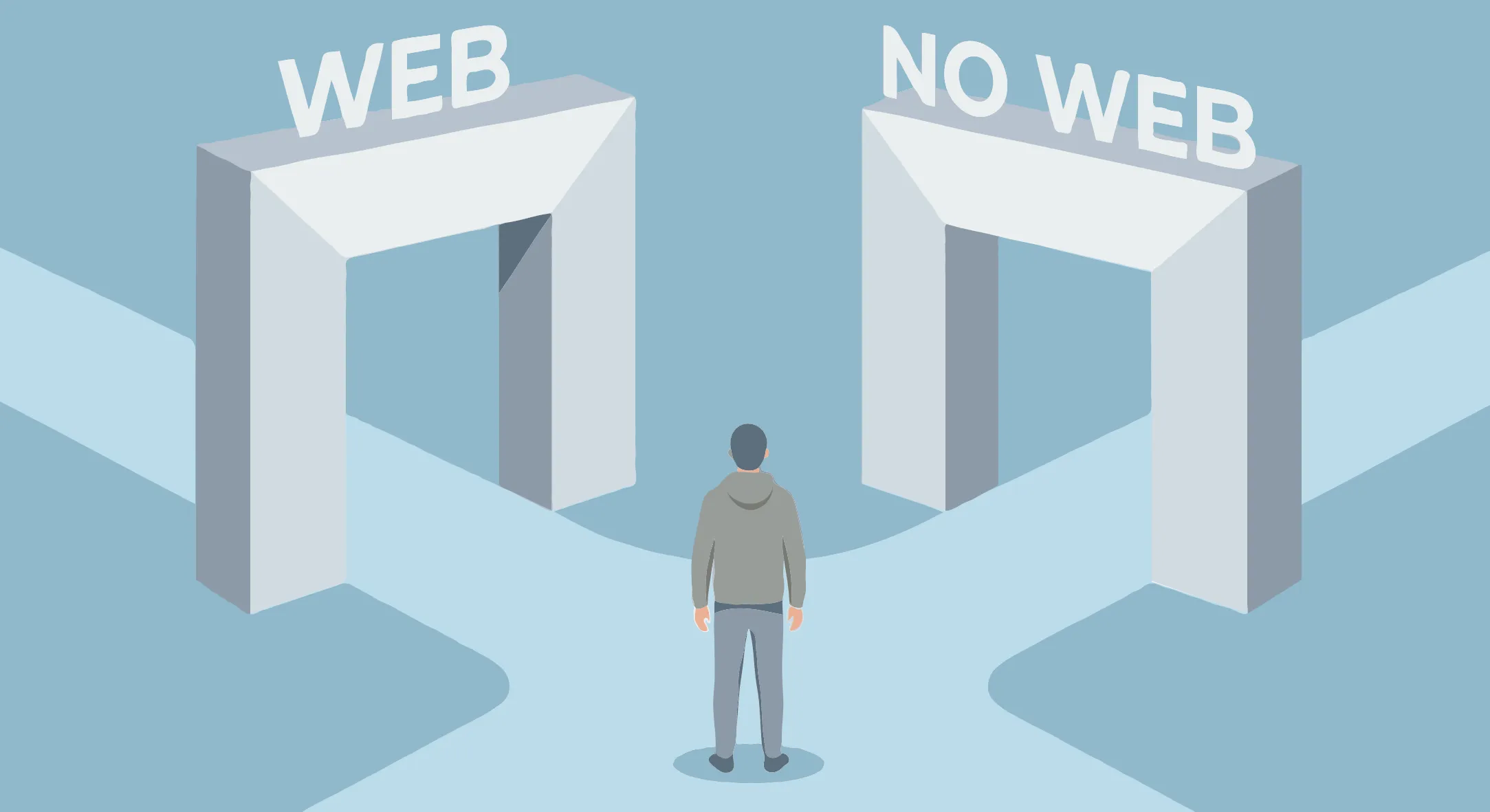
Standing at the crossroads of web versus no web is where many business owners find themselves in 2026. With social media platforms, marketplaces, and AI assistants changing how customers discover businesses, the question of whether a website is still worth the investment deserves a thoughtful answer.
The short version: for most businesses, yes. But the real answer depends on your goals, industry, and how you plan to use it.
The State of Websites in 2026
Despite predictions that websites would become obsolete, they remain the foundation of online business presence. According to Statista's global digital population data, over 5.5 billion people use the internet worldwide. Your website is often the first impression potential customers have of your business.
Where Customers Research Before Buying
The data shows that company websites remain the primary research destination for customers making purchase decisions. While social media and other platforms drive awareness, the website is where trust is built and decisions are made.
The 2026 Debate: Are Websites Dying or Evolving?
There are two competing narratives in the digital marketing world right now. Understanding both helps you make a smarter decision.
The Case Against Websites
Critics point to significant shifts in how people find information online:
Zero-Click Searches - According to SparkToro and Datos, 58.5% of searches in the US and 59.7% in the EU now end without a click to any website. Users get their answers directly from Google's AI summaries.
Declining Search Volume - Gartner projects a 25% drop in traditional search volume by 2026 as users shift to AI chatbots like ChatGPT for answers.
Referral Traffic Collapse - The Reuters Institute reports publishers facing a 40% decline in referral traffic from search engines.
AI Content Flood - Harvard Business Review reports 54% of business content is now AI-assisted, creating what researchers call "content noise" that makes standing out harder.
The Zero-Click Reality
The Case For Websites
However, proponents argue the data tells a different story when examined closely:
Quality Over Quantity - While search volume dropped, conversion efficiency on well-designed sites increased significantly, with the top 10% of landing pages converting at 3-5x the average rate. Fewer visitors, but far more valuable ones.
AI Needs Source Material - AI summaries require websites to exist. If your content is not on your website, AI cannot cite it or learn from it. Your website becomes the "training data" for how AI understands your business.
B2B Verification - Despite all digital channels, 97% of B2B buyers say website content impacts their purchasing decisions according to the Demand Gen Report B2B Buyer Behavior survey.
Platform Risk - Social media algorithms change constantly. TikTok faces potential bans. Marketplaces increase fees. Your website is the only digital asset you fully own.
Email Marketing ROI - Email marketing delivers an average 3,600% ROI according to Litmus, meaning $36 returned for every $1 spent, but it requires a website to capture leads in the first place.
What This Means For You
The "death of websites" narrative is really the death of mediocre websites. Generic, slow, poorly designed sites are indeed becoming invisible. But distinctive websites with real expertise, fast performance, and clear value propositions are more important than ever. Web usability expert Steve Krug, author of "Don't Make Me Think," has long argued that clarity and ease of use are what separate effective websites from noise — a principle that holds even more true in the age of AI-driven search.
The winners in 2026 are not choosing between having a website or not. They are choosing between having a strategic digital hub or becoming invisible to both humans and AI.
Website Costs: A Breakdown by Type
One of the biggest sources of confusion is pricing. Website costs vary based on what you need. Here is what each tier typically includes and why prices differ.
What Each Tier Actually Includes
DIY/Builder ($0-$300) - Platforms like Wix, Squarespace, or WordPress.com. You pick a template, add your content, and publish. Good for testing ideas or personal projects. Limited design flexibility and you typically pay monthly fees.
Starter Site ($500-$1,500) - A developer builds a simple site for you. Usually 1-5 pages: home, about, services, contact. Includes mobile responsiveness and basic contact form. Works well for freelancers, consultants, or anyone needing a professional online presence without complexity.
Small Business ($1,500-$5,000) - A proper business website with 5-10 pages, custom design that matches your brand, content management system so you can update text yourself, basic SEO setup, and integration with Google Analytics. This is where most local businesses land.
Professional ($5,000-$10,000) - Everything above plus: completely custom design, advanced functionality like booking systems or member areas, CRM integration, multiple contact forms, blog setup, and more sophisticated SEO. Suited for businesses serious about lead generation.
E-commerce ($3,000-$15,000) - The range depends on your product count and complexity. A basic Shopify or WooCommerce store with 50 products sits at the lower end. Larger catalogs with custom filtering, multiple payment methods, and shipping integrations push toward the higher end.
According to the Nielsen Norman Group's UX research, users form opinions about websites in 50 milliseconds. The investment level should match how important first impressions are for your business.
Calculating Website ROI
The question is not whether websites cost money but whether they return more than they cost.
Average Website ROI by Industry
The Lead Generation Math
Consider a local service business. A website costing $3,000 to build with $100 monthly for hosting and maintenance. If that website generates just two new customers per month at an average value of $400 each, the annual return is $9,600 against a first-year cost of $4,200.
That is over 125% return in year one, improving each subsequent year as the initial investment is paid off.
For businesses with higher customer values, the math becomes even more compelling. A B2B company landing one $5,000 contract from their website covers the entire investment.
When Websites Are Worth It
Not every business needs the same web presence. Here is when investing makes clear sense.
You Sell Services or Products Online
If customers can purchase directly through your website, the ROI calculation is straightforward. E-commerce development has become more accessible, and platforms like Shopify report that businesses with professional websites convert 2-3x better than those using marketplace listings alone.
You Need to Build Trust
Professional services, healthcare providers, legal firms, and consultants all benefit from websites that establish credibility. A well-designed site with case studies, testimonials, and clear expertise signals separates you from competitors.
According to Stanford's Web Credibility Research, 75% of users judge a company's credibility based on their website design.
You Want to Be Found on Google
Search engines drive significant business discovery. If potential customers search for what you offer, appearing in results matters. Proper search engine optimization requires having a website to optimize.
Traffic Source Value Comparison
Organic search typically accounts for over half of all website traffic for businesses that invest in SEO. Without a website, you cannot capture this traffic.
You Run Paid Advertising
If you invest in PPC advertising, you need somewhere to send that traffic. Landing pages on your own website convert better than sending paid traffic to social profiles or third-party platforms.
Google's landing page guidelines explicitly state that ad quality scores depend on landing page experience. Better landing pages mean lower ad costs and better results.
You Want Control Over Your Business Presence
Social media platforms change algorithms, marketplaces adjust fees, and third-party sites can shut down. Your website is the one digital property you fully control.
When a Website Might Not Be Priority
There are situations where other investments make more sense first.
You Are Testing a Business Idea
If you are validating whether customers want what you offer, starting with a simple landing page or social presence can provide answers faster and cheaper than a full website.
Your Customers Do Not Use the Internet
Some hyperlocal businesses serving older demographics may get adequate results from offline marketing. This is increasingly rare but still exists.
You Lack Budget for Quality
A poorly made website hurts more than helps. If you can only afford a clearly amateur site, focusing budget elsewhere until you can invest properly may be wiser.
Website Types Explained
Informational Websites
These sites present your business, services, and contact information. They establish presence and credibility without complex functionality.
Typical cost: $1,500 - $5,000
What you get: 5-10 pages, custom design, mobile-friendly layout, contact forms, Google Maps integration, basic SEO, content management system
Best for: Service businesses, professionals, local companies
Our web development services help businesses create professional informational sites that convert visitors into leads.
E-commerce Websites
Online stores require product catalogs, shopping carts, payment processing, and shipping setup.
Typical cost: $3,000 - $15,000
What you get: Product pages with images and descriptions, shopping cart, secure checkout (Stripe/PayPal), shipping rate calculator, inventory tracking, order notifications
Price factors: Number of products, payment gateway needs, shipping complexity, custom features like size guides or product configurators
Best for: Retailers, craftspeople, anyone selling physical or digital products
According to Shopify's commerce trends report, global e-commerce sales continue growing 8-10% annually, making online selling capability increasingly important.
Lead Generation Websites
These sites focus on converting visitors into contacts through forms, calls, or chat.
Typical cost: $3,000 - $8,000
What you get: Strategic landing pages, multiple contact forms, call tracking setup, live chat integration, case study pages, resource downloads, CRM connection
Best for: B2B companies, professional services, high-value sales
Web Applications
Custom functionality beyond standard websites, including member portals, booking systems, or specialized tools.
Typical cost: $10,000 - $50,000+
What you get: User accounts and authentication, database-driven features, custom workflows, API connections to other software, admin dashboards
Price factors: Complexity of features, number of user roles, integration requirements, security needs
Best for: SaaS businesses, organizations with unique processes
Web application development requires specialized expertise but enables business models impossible with traditional websites.
Ongoing Costs to Plan For
The initial build is just part of the picture. Smart planning accounts for ongoing needs.
Hosting and Domain
Expect $100 - $300 annually for reliable hosting and domain registration. High-traffic sites or those needing extra speed may run $20-50 monthly.
Security and Maintenance
Websites require updates, security patches, and occasional fixes. Budget $50 - $200 monthly for website maintenance and support or plan to handle it internally.
Content Updates
Static websites become stale websites. Plan for regular content updates, whether you handle them or pay someone. Fresh content also supports SEO performance.
Marketing Integration
A website without traffic produces no results. Budget for SEO services, PPC advertising, or other traffic generation.
Ongoing Monthly Website Costs
Making the Decision
The website investment question comes down to three considerations:
1. What Are Your Growth Goals?
Businesses planning to grow typically need websites. The investment scales with ambition. A local shop might need a simple site, while a company targeting national markets needs comprehensive custom website development.
2. How Do Customers Find You?
If customers search online, you need to appear. If they rely on referrals, your website validates recommendations. If they walk by your storefront, a website extends your reach beyond foot traffic.
3. What Can You Afford to Do Well?
A well-executed simple website beats a poorly made complex one. Start with what you can do properly and expand as resources allow.
Getting Started
If you have decided a website makes sense for your business, here is how to proceed.
Define Your Goals
Know what you want the website to accomplish. Lead generation? Direct sales? Credibility building? Clear goals guide every decision.
Research Your Options
Get multiple quotes. Ask about included services, ongoing costs, and ownership rights. Review portfolios and references.
Plan for Success
A website alone does nothing. Plan for traffic generation through SEO, paid advertising, or other marketing. Website speed optimization ensures visitors have a good experience once they arrive.
Start the Conversation
Ready to discuss your website needs? Contact our team for a free consultation to explore options that fit your business and budget.
Summary
Websites remain one of the most valuable business investments in 2026. Costs range from a few hundred dollars for DIY solutions to several thousand for professional sites with custom features.
The key is matching investment to goals. A local service business does not need an enterprise platform. An ambitious e-commerce company should not cut corners on their digital storefront.
For most businesses, the math works clearly in favor of website investment. As Jakob Nielsen, co-founder of the Nielsen Norman Group and a pioneer in web usability research, has consistently shown, investing in user-centered design yields returns of $2 to $100 for every dollar spent. The question is not whether to have a website but what kind of website best serves your specific situation.
Standing at the crossroads between web and no web, the path forward usually leads to web. The only question is how to walk it wisely.