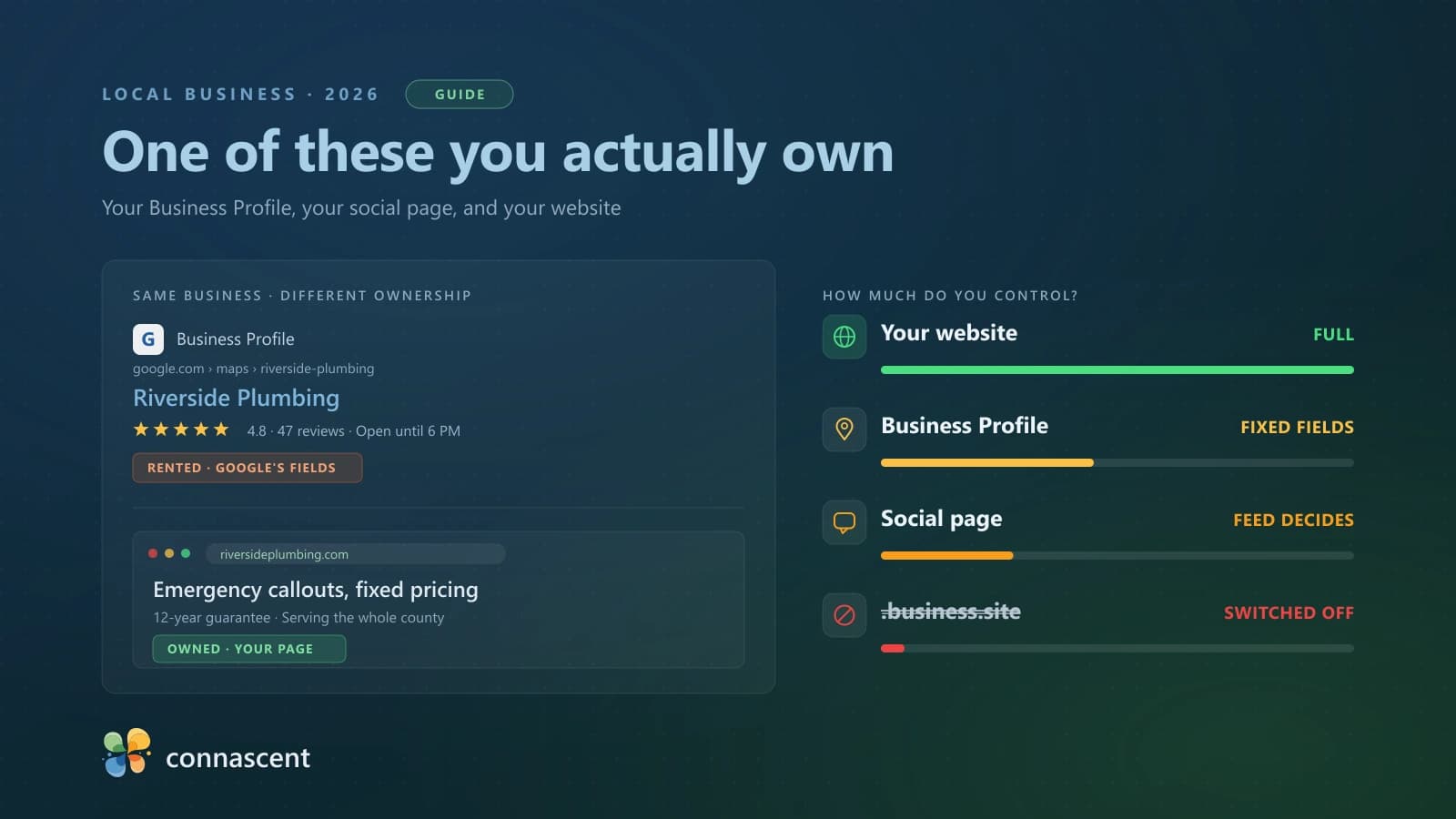
In March 2024, Google switched off every website it had built for business owners.
These were the free sites that came attached to a Google Business Profile, living on .business.site addresses. For a few months the old URLs redirected to the profile itself. After 10 June 2024 they returned a page not found error, and Google's advice was to point the profile at a new website built somewhere else. Wix, Squarespace, GoDaddy, Google Sites, Shopify, WordPress. Six suggestions for starting over, and not one of them was the product Google had just switched off.
A Business Profile does real work. The question worth asking is what happens to your business when the company holding it changes its mind.
The short version
- Yes, most local businesses still need one, because the profile and the site do different jobs.
- Your Business Profile is how people find you. Your website is where they go once they are interested, and 54% now do exactly that after reading your reviews.
- Asking AI for a local recommendation went from 6% of consumers to 45% in a year, and Google requires an indexed page before it will cite you in an AI answer.
- The profile sits on rented ground: fixed fields, suspension risk, and a track record of being switched off.
- A handful of local businesses can genuinely wait. It depends on whether your customers compare you before they call.
So, does a local business still need a website?
Most local businesses still need a website in 2026, because a Google Business Profile and a website do different jobs. The profile wins you the discovery moment. The website is what people check before they commit, what your ads and AI answers point at, and the only part of your presence that cannot be switched off by someone else.
What the numbers say
Isn't my Google Business Profile enough?
This is the real question hiding inside "do I need a website," and it deserves a straight answer.
For some searches, the profile is enough. Someone who already knows your name, wants your number, and is standing three streets away will never open your website. They will tap the call button in the local pack and that is the end of it. If you optimize nothing else this year, optimize the profile.
The trouble starts when the customer is comparing rather than confirming.
What people do right after reading your reviews
BrightLocal's 2026 Local Consumer Review Survey asked 1,002 US adults what they do after reading positive reviews about a business. 54% said they then check the business's website. In 2019 that figure was 32%.
Read that as a sequence rather than a statistic. Your reviews did their job, the customer is interested, and their next instinct is to look you up properly. If there is nothing to look up, you have spent your best reviews driving people to a dead end.
BrightLocal also found Google's share as a source of local reviews slipped to 71%, down from 83% a year earlier, with other platforms picking up ground. Where people go to check out a business is spreading out across AI assistants, social feeds and marketplaces, and the fastest-growing of those gets a section of its own below. Every one of those places eventually asks the same question. Where can I read more about this business?
What you can't control on a Business Profile
Your profile has slots. Name, category, hours, photos, a short description, some posts. You fill in the slots. You do not decide what appears above the fold, which of your services gets emphasis, or what a first-time visitor reads first, because Google decides that and changes it whenever it likes.
That is fine for a plumber with one service and a phone number. It gets thin fast if you need to explain a process, publish prices that come with conditions, show your work properly, or answer the five objections that stop people booking.
Your profile can be suspended, or switched off entirely
Two things have already happened here, and both are worth knowing before you decide the profile is your whole presence.
The first is the 2024 shutdown above. Google built a website product, tied it to profiles, and retired it. Owners had a few months of redirects, then 404s.
The second is suspensions. Search Engine Journal reported in March 2025 that suspensions had climbed sharply since the start of that year, with resolution times stretching from roughly five days to nearly five weeks, and no explanation from Google despite heavy demand on its support channels. Some businesses were suspended after ordinary edits to a name, address or category.
The mechanics keep moving, too. For about three years, appealing meant submitting first and then racing a separate evidence form with a 60-minute window and one file per upload slot. Google changed that on 8 July 2026: documents now attach inside the appeal form itself, through a single button that accepts multiple files. It is a real improvement. It also changes nothing about what Google accepts as proof, or how long you wait.
Easier paperwork is not the same as a safety net. You are still proving your own business exists, on Google's timetable, while the phone does not ring. That is worth sitting with if the profile is currently doing all the work.
A suspension is survivable when your website, your phone number and your booking page keep working. It is a genuine emergency when the profile is the business.
What about just a Facebook or Instagram page?
A Facebook or Instagram page can sit alongside a website. It cannot do the website's job, because you are renting the audience and the rules at the same time.
Same shape of problem, different platform.
A social page gives you things a website struggles to match: reach, recency, and a place where people already are. Keep it. The catch is that everything about it is borrowed. You do not control the layout, you cannot guarantee the people who followed you will see what you post, and an account lockout takes the whole thing with it.
There is also a format mismatch that gets overlooked. Feeds are built to be scrolled past. Your opening hours, your service area and your prices are reference information, and reference information does badly inside a feed. People do not scroll back eleven weeks to find your holiday hours.
Social media works best when it points at something permanent. We covered what Google actually indexes from social platforms separately, and the short version is that social is distribution, not search value: the links you post there pass no ranking credit back to your site, and a post that does get indexed is still a page on someone else's domain. Social is very good at sending people somewhere. It still needs a somewhere to send them.
Can't AI just recommend me without a website?
This is the newest version of the question, and it stopped being hypothetical some time in the last twelve months. BrightLocal's 2026 survey found the share of consumers asking ChatGPT or a similar tool for a local recommendation rose from 6% to 45% in a single year, which puts AI third behind only Google and Facebook. Across the same 1,002 consumers, more now say they trust AI platforms to recommend a business (40%) than say they do not (32%).
It also has the cleanest answer on this page, because Google has written it down.
From Google's documentation on AI features:
To be eligible to be shown as a supporting link in AI Overviews or AI Mode, a page must be indexed and eligible to be shown in Google Search with a snippet, fulfilling the Search technical requirements.
A page. Indexed. That is the entry requirement. If you have no site, there is no page for an AI answer to cite, and the assistant recommending local businesses in your category has nothing of yours to point at.
Worth killing a myth while we are here, because a lot of people are being sold the opposite. The same documentation says there are no additional requirements to appear in AI Overviews or AI Mode, no special optimizations, and no special schema.org structured data you need to add. There is no separate AI checklist to buy, and we went through Google's guidance on that line by line in our AI SEO playbook for local businesses. The work is ordinary, decent SEO, starting with a site you control, which is why our guide to appearing in ChatGPT answers and AI Overviews is mostly about writing clear pages and getting mentioned in the places the assistants already read.
Your Business Profile still matters here. It feeds local results and AI answers about businesses near someone. It just is not a web page, so it cannot be the thing that gets cited, quoted or linked.
What you own versus what you rent
Every argument above is the same argument wearing different clothes. Some of your presence you own, and some of it you rent.
Renting is not a mistake. Rented ground is where the people are, and a local business that ignores its Business Profile to focus on its website has the priorities backwards. The mistake is having only rented ground, so that a category change, a suspension or a retired product takes your entire presence with it.
Which local businesses can wait?
Not every business is exposed to that equally, and some can leave this alone for a while. Budget is the usual way that call gets made, and it is the wrong axis. The useful question is whether your customers compare you before they choose.
You can probably wait if:
- You are booked out from referrals and word of mouth, and turning work away
- You sell through a marketplace that owns the transaction anyway, such as a food delivery platform or a trades directory
- You are still testing whether the service sells, and a profile plus a phone number is a faster experiment
- Your customers decide in the local pack, on price and proximity, and never compare
You have already outgrown it if:
- You pay for any advertising, since ads need a destination you control and Google Ads links had to be updated separately when profile sites shut down
- Customers ask the same three questions before booking, which means they wanted a page and did not find one
- You compete on searches where people weigh up two or three businesses
- You have anything to explain: a process, a guarantee, conditional pricing, credentials, a portfolio
- Losing your profile for five weeks would stop the phone ringing
That last one is the honest test. If a suspension would be an inconvenience, you can wait. If it would be an emergency, you are already relying on something you do not own.
What a local business website actually needs
Not much, and this is where people talk themselves out of it. The minimum useful version is small:
- Who you are, what you do, and where you do it, in text a crawler can read
- The services you offer, one page each if they are different
- Your hours, service area and contact details, matching your profile exactly
- Proof: photos of real work, reviews, credentials
- One obvious way to get in touch
That is a handful of pages. It is not a rebuild of your business, and it is not the multi-year project that the word "website" tends to summon. If you want the cost side of the decision, we broke down what websites cost and when they pay for themselves separately, and why SEO matters for a small business covers what happens once the site exists.
One line in that list matters more than it looks. Your name, address and hours should be identical on the site and the profile, because that agreement is part of how Google works out that both refer to the same business. The site and the profile are not rivals here. They corroborate each other.
If $100 is easier than a decision
Plenty of owners read all of this, agree with it, and still do not want to commit a few thousand dollars to find out whether it works for them. That is a fair position. It is also why we build a starter page for $100.
The $100 starter page
- One page, designed and built for your business. Not a template with your logo dropped in.
- Domain and hosting included for the first year.
- Booking and analytics wired in from the start, not bolted on later.
- On-page SEO done as part of the build, so it can actually be found.
- You keep 100% of the code.
- Built to expand, so adding pages later doesn't mean starting again.
- No hidden fees, no lock-in, no monthly surprise. $100.
Two of those matter more than the rest given everything above. You own the code outright, which means the thing you just built is yours in the way a profile never is. If it works, it grows. If we fall out, you take it with you.
One caveat worth saying plainly: this is not on our services pages and it is not a permanent price. It runs until 31 December 2026, and it is for people who read this article and got something out of it. If that is you, ask us for it here and mention this post.
Where this leaves you
The businesses that came through the 2024 shutdown without noticing were the ones whose .business.site page had been a placeholder for a real site all along. The ones who lost something were the ones for whom it was the whole shop window.
Keep the profile. Feed it, get reviews, and rank it properly. Then give it somewhere to send people, on an address that is yours, so the next time a platform changes its mind you find out from a blog post instead of from your phone not ringing.
If you want a hand with the second part, that is what we build. The $100 starter page is the cheapest way to find out whether it moves anything for you, and until the end of 2026 you can claim it here.