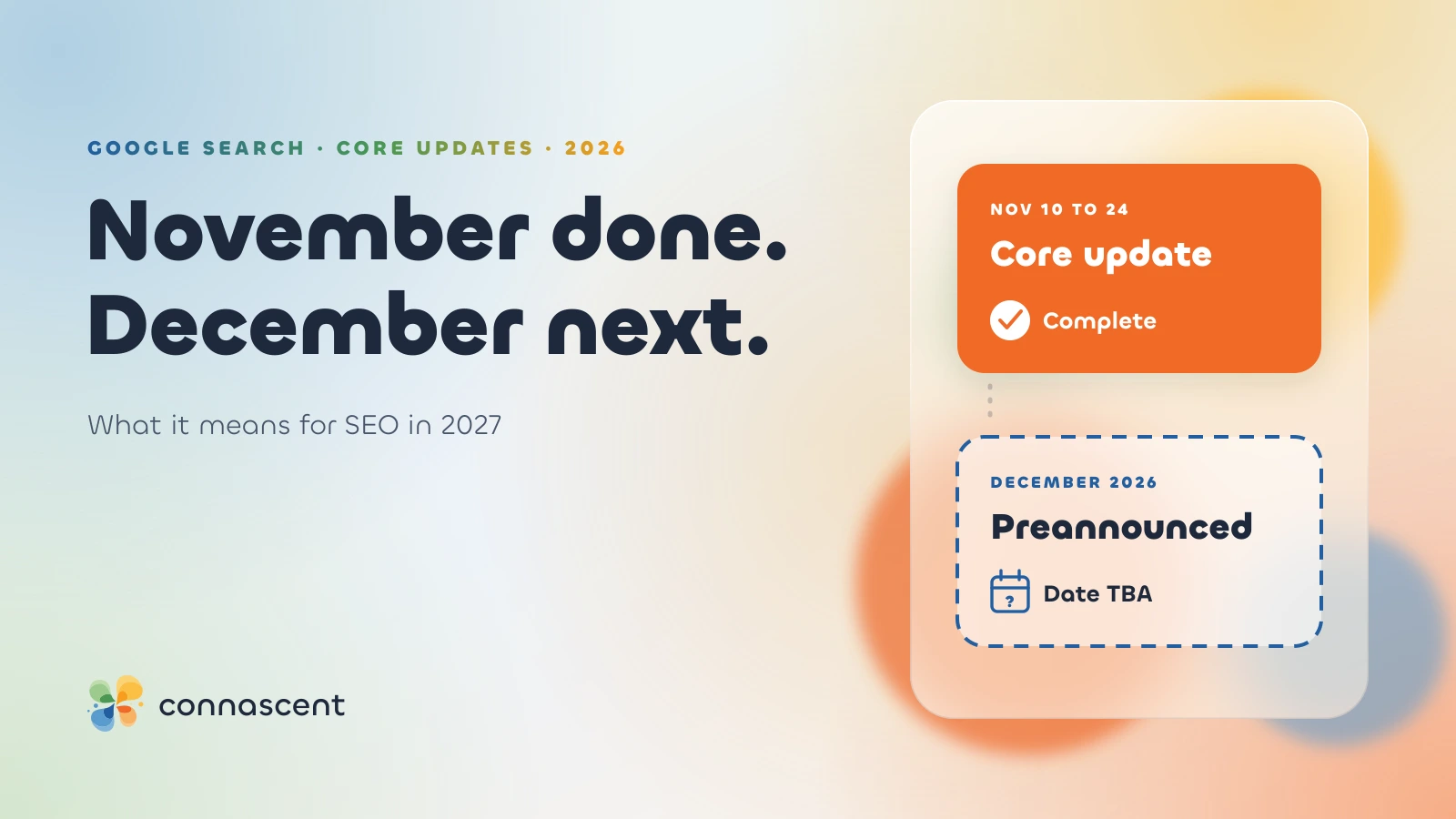
Google finished its November 2026 core update on 24 November. The same day, it told everyone the next one is already on the way.
That second message is the real news. Core updates usually arrive with a same-day note and two weeks of guesswork. This time Google posted a December core update to its Search Status Dashboard weeks ahead, without a date, because of new rules in the UK.
So if your business depends on Google, you have one update to make sense of and another to prepare for, with less than a month between them.
The short version
- The November 2026 core update ran from 10 to 24 November and applied to every country and language.
- UK data from SISTRIX shows platforms such as YouTube up, and reference sites and publishers down. We have found no trusted data yet for the US, Canada or Australia.
- The clearest pattern: templated content sections fell hard while product and brand pages held.
- A December core update is preannounced. Google gave no date and says it is not imminent.
- Wait a week, read clean data, and fix the weak sections, not the whole site.
The November 2026 core update at a glance
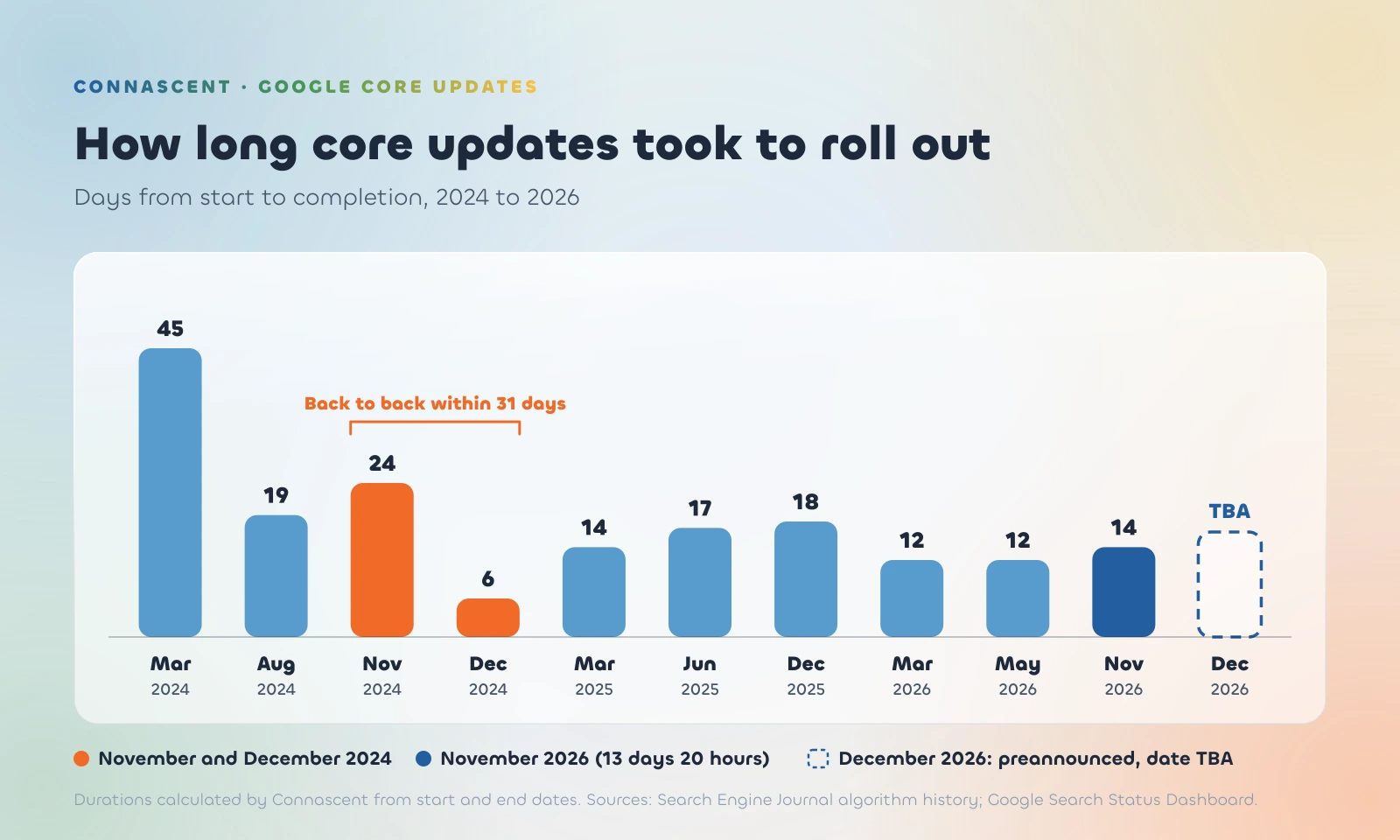
Google released the update on 10 November with the usual wording: it "applies globally and to all languages" and "may take up to 2 weeks". It came in just under that. "The rollout was complete as of November 24, 2026," the dashboard says, for a total of 13 days and 20 hours.
It was the third core update of the year, after March and May, with three spam updates since June. In a LinkedIn post, Google called it "a regular update designed to better surface relevant, satisfying content for searchers from all types of sites," as Search Engine Roundtable reported.
The November update in four numbers
What Google said, and what it didn't
Google named no targets. Its core updates documentation says these changes "are broad in nature, and don't target specific sites or individual web pages." A drop after a core update is not a penalty in the manual-action sense. Google reassessed how useful your pages are compared with everything else that could rank for the same searches, and other pages came out ahead.
Who won and who lost
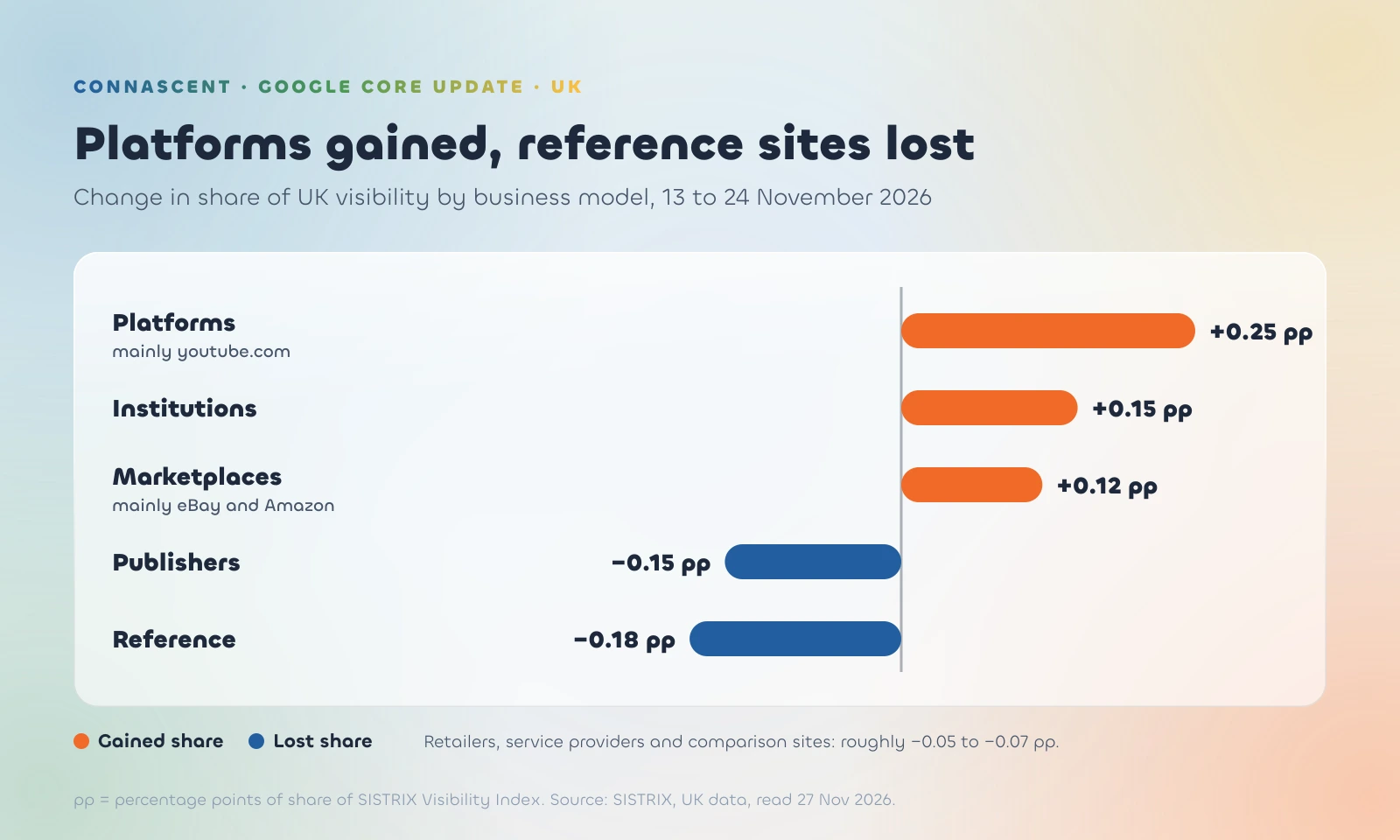
One caveat first. The only trusted winner-and-loser data so far comes from SISTRIX, and it covers the UK. We have found no comparable trusted data for the US, Canada or Australia, so treat the UK picture as a strong hint, not a map of your market.
Platforms up, reference sites and publishers down
SISTRIX's own summary is cautious: "There's no stand-out sector or content-model shift." Still, the business-model figures lean one way. Platforms gained, mainly through YouTube, along with institutions and marketplaces such as eBay and Amazon. Reference sites and publishers lost ground.
At domain level, the losers were a mix of reference sites, listings and retail:
How much UK visibility these sites lost (SISTRIX, Nov 13-24, 2026)
On the winning side, youtube.com rose 6.54%, x.com 18.99%, deepl.com 58.96% and the UK data regulator's site, ico.org.uk, 106.02%. Some of those start from a small base, so the percentages look bigger than the traffic behind them. Some big moves have nothing to do with content quality, though. SISTRIX notes that "a number of large-scale migrations were caught up in the Core Update," so a site that changed domains or platforms this autumn can't read its chart in isolation.
The real pattern: whole sections, not whole sites
The most useful observation came from SEO consultant Lily Ray, reported by Search Engine Journal. She looked at six sites that lost heavily. Each had a section that repeated one template thousands of times: a page per word, per area code or per "X vs Y" pairing. Most of those pages targeted searches with little to do with what the business sells. Her summary: "the content section (blog, resources, etc.) is falling hard while the main product/brand pages stay strong."
That is one expert's review of six sites, not a study. But it fits what Glenn Gabe said: two domains he saw drop heavily "were scaling heavily via AI-generated content".
Does your site have a section like that? Ask three questions:
- Does one folder hold hundreds of pages built from the same layout, with only a keyword swapped?
- Would a customer who lands on one of those pages ever buy from you?
- Did that folder lose more than your service or product pages?
Three yeses mean you have found where to start. One or two yeses still deserve a closer look: open that folder's pages in Search Console and check whether they bring enquiries or only visits. If no folder fits the description and the whole site dropped evenly, the cause is more likely site-wide, such as thin service pages or weak trust signals, and the checklist below covers those too.
Ecommerce took a hit
UK retail had a rough two weeks. Measured between 11 and 25 November, SISTRIX puts the combined visibility of apparel sites down 4.9%, "with 44% of its domains losing visibility". ASOS lost 14.27%. Health and beauty sites moved at 3.8 times their normal weekly volatility, the worst possible timing with Black Friday on the way.
UK ecommerce during the update (SISTRIX)
If you sell online outside the UK, don't assume the same hit. Check your own category pages first, using the method in the next section.
Before you panic: read your own data the right way
November's numbers are messier than usual. Several unrelated events landed just before, during or after the rollout, and each can look like an update effect. Google itself recommends waiting at least a full week after a core update completes before you analyse your site in Search Console. For this update, that means 1 December.
The first three traps need a word of explanation.
Some sites saw a jump in Search Console clicks between 31 October and 2 November. Marie Haynes put that spike down to bots, as the same SEJ article reports. A baseline that includes those days makes any later period look worse.
Google confirmed that a logging error lowered impressions in the Generative AI performance report from 9 to 11 November. The error affects the data only. Your real visibility did not change.
On 12 November, Google made Gemini 4 Hydrogen available in Search for all users. Search Engine Journal reported that, according to an X thread by Google's Robby Stein, it became the default model in AI Mode and also handles the hardest questions in AI Overviews. AI citations can change for that reason alone.
Then compare two clean weeks. Use 3 to 9 November as the "before" week. Use 25 November to 1 December as the "after" week. In Search Console, add a page filter for each folder, such as /blog/ or /services/. A site-wide total hides the section that moved. Our guide to the Search Console Generative AI report explains the AI side of the data. Remember that this report shows impressions only, not clicks.
Google just warned us about December. Here's why
On the day November finished, the dashboard preannounced the December 2026 core update. It "focuses on multiple improvements to how our systems understand and rank relevant content (including for longer and more complex questions), as well as improving personalized results for people who have personalization turned on." It covers all locations and languages, and "is scheduled to be released in December 2026."
A Google spokesperson told Search Engine Roundtable: "We don't have a date yet -- we will announce it as usual the day it starts rolling out. It's not imminent."
Advance notice itself isn't new. Google gave a day's warning before the June 2019 core update. What is new is a notice weeks ahead, posted on the dashboard with no date, under the UK's new fair-ranking rules.
What the UK's CMA rules require
On 17 June 2026, the UK Competition and Markets Authority (CMA) imposed a fair-ranking conduct requirement. The requirement makes Google rank organic results on objective and non-discriminatory criteria. This includes the generative AI features in Search.
The CMA's decision sets these rules:
- Google must comply by 17 December 2026.
- Google must give at least 30 business days' notice of changes where publishers could act to avoid or reduce the impact.
- The minimum is 15 business days for changes that may cause significant ranking shifts and that Google can explain.
- If 50 publishers send feedback on a material change within 30 business days after it takes effect in the UK, Google must report to the CMA.
- The rules cover organic results, including AI features. They do not cover ads.
Google's stay-informed page confirms the link. It gives advance notice "for changes where UK users may experience a significant ranking shift." The page gives no fixed notice period.
What it means if you're in the US, Canada or Australia
The duty to give notice is British. The dashboard is global. So everyone gets the warning that Google writes for the UK.
We know of no rule like the UK's in Canada or Australia. Canada's Competition Bureau is suing Google, but over online advertising tools, not search rankings. In March 2026 the Competition Tribunal dismissed Google's constitutional challenge, and the case continues. Australia's government proposed a digital competition regime in December 2024, with app stores and ad tech as the first services to examine. Search is not on that first list. So if you're in Toronto or Sydney, the dashboard feed is your warning system, the same as in London or Chicago.
Elsewhere, regulators are pressing in other ways. In July the European Commission fined Google €890 million under the Digital Markets Act, €460 million of it for favouring its own services in Search. The Commission also noted Google's proposals for applying the decision to AI Overviews and AI Mode. Google appealed in October. In the US, both sides appealed the final judgment in the search antitrust case, and the appeals remain pending, according to Alphabet's latest quarterly filing.
Our take: expect advance notice for most big core updates from now on, because a global dashboard is simpler for Google than a UK-only one. Don't build your plans on it, though. Google hasn't promised notice for every update or for any market outside the UK.
When will December's update start?
Google won't say, so here is our call. Our take: we expect it in the second half of December. "Not imminent" on 24 November makes the first days of the month unlikely. The CMA deadline of 17 December also suggests Google wants its new notice process running first. There is a precedent for a short gap, too: in 2024, the December core update followed November's within 31 days.
Whatever the date, treat every day from now as possible. Subscribe to the dashboard's RSS feed so you see the start notice when it goes up, and do the preparation now.
Where SEO is going in 2027: five signals
Each signal below starts with what Google or the data says. Our view follows, labelled as ours. Here is the summary before the detail.
1. Rankings and AI answers are one system
Google's ranking principles say "No result receives preferential treatment," and that AI Overviews, carousels, images and videos "are evaluated using the same criteria." Its AI attribution documentation states: "Search generative AI features are integrated directly with Google's core Search ranking and quality systems".
Our take: there is no separate "AI SEO" to buy. A core update that moves your rankings will also move your AI citations. Lily Ray saw AI citations drop alongside rankings on her six sites. The logging error and the Gemini change muddy that data, but the direction matches what Google's own documents say. Our post on AI search optimisation covers what that means for your pages.
2. Longer, conversational questions are next
December's update targets "longer and more complex questions". Google's AI documentation explains how its AI features handle such questions. The model can run several related searches for one question. Google calls this "query fan-out". The model then checks its answer against sources such as web results and the Knowledge Graph. Only pages that are indexed and can show a snippet can appear as supporting links.
Our take: the pages that win in 2027 answer the whole question a customer asks, including the follow-ups. The long, three-part questions you hear on sales calls are a better brief than any keyword list. We wrote about how to appear in ChatGPT and AI Overviews with that in mind.
3. Fewer clicks per search, so each visit has to count
The click data points one way, with caveats. SparkToro found that 68.01% of US Google searches ended without a click from January to April 2026, up from 60.45% in 2024. Rand Fishkin calls that comparison "apples and oranges", because the two years use different panels, so read it as a direction, not a precise change. In a randomized field experiment with about 1,000 US users, the economists Saharsh Agarwal and Ananya Sen found that AI Overviews cut organic clicks by 39.8% and raised no-click searches by 34.5%. The paper is a working paper, not yet peer-reviewed; the link goes to the study's summary page at the Indian School of Business.
Both studies use US data. Google lists the UK, Canada and Australia among the countries where AI Overviews are available, so we expect the same direction there. We have not found comparable studies for those markets yet.
Clicks in the age of AI answers (two separate studies)
Google disagrees. In August 2025, Liz Reid, who leads Search at Google, wrote that total organic click volume has been "relatively stable year-over-year", though Google published no figures.
Our take: plan for fewer visits per ranking. A visit that turns into a call or an enquiry is worth more than ten that bounce, so measure that.
4. Being cited is not the same as being visited
AI Overviews link to sources, but those links are moving down the answer. A tracker run by Peec AI found the share of AI Overviews with the first link in the top third of the answer fell sharply in two months. It is one vendor's tracker, the method isn't public, and Google hasn't explained the change.
AI Overviews with the first link in the top third
Our take: count AI citations, but don't treat them as traffic. When the link sits lower in the answer, a brand people already know has a better chance of getting the click. That is why we look at whether an SEO budget buys AI brand mentions, not only links.
5. Personalization makes "my ranking" a fuzzier idea
December's update also improves "personalized results for people who have personalization turned on." Google hasn't said how big that change is. But for anyone with personalization on, the page they see for a search can differ from the page your rank tracker sees.
Our take: a single position in a rank tracker will mean less in 2027. Track the things that pay: leads, calls, bookings and sales by channel. For local firms, our Google AI SEO playbook for local businesses shows where to start.
Your get-ahead checklist before December
Work through these steps in order. The first five matter most.
- Wait until 1 December. Then compare 3 to 9 November with 25 November to 1 December.
- Split Search Console data by folder: blog, resources, location pages, product pages and service pages.
- Find templated sections that repeat one layout at scale. Flag pages that target searches unrelated to what you sell.
- Improve or merge weak pages. Noindex unrelated templated sections. Delete content only as a last resort.
- Check that your articles and filter pages do not outrank your own category or service pages.
- Add clear sources, author bios and an About page.
- Do not change a page's date unless the content changed substantially. Google says this in its AI guidance.
- Confirm that key pages are indexable and can show a snippet.
- Write answers to the long, multi-part questions customers ask on sales calls.
- Track the Generative AI report together with clicks, leads and calls.
- Subscribe to the Search Status Dashboard RSS/Atom feed. Google posts the December start notice there.
- If results got worse, send feedback in Search Console with the tag #NovemberCoreUpdate2026. Google says feedback does not cause manual ranking changes.
- Plan for months, not days. Recovery can take until the next core update.
If step 4 means rewriting or merging a whole folder, that is the kind of job our SEO content writing team does.
What we'll watch next, and how we can help
We're watching two dates. The first is the December start notice on the dashboard. The second is 17 December, when Google's UK notice process has to be in place. After that, look to spring: Google ran a core update between March and May in each of the past three years, so our call for the first update of 2027 is that window.
The lesson from November is simple. Sections built to catch searches rather than serve buyers lost, and product and service pages held. December's focus on long questions and personal results points the same way. If you're not sure which of your sections Google now sees as weak, start with an SEO audit. If you want the fixes done before the next update, that's what our SEO services are for.